
The Scrap Factor: How Recycled Nickel and Molybdenum Shape Your 2027 Stainless Steel Costs
By Jason — goodsteel Technical Analysis Department | 23 November 2026
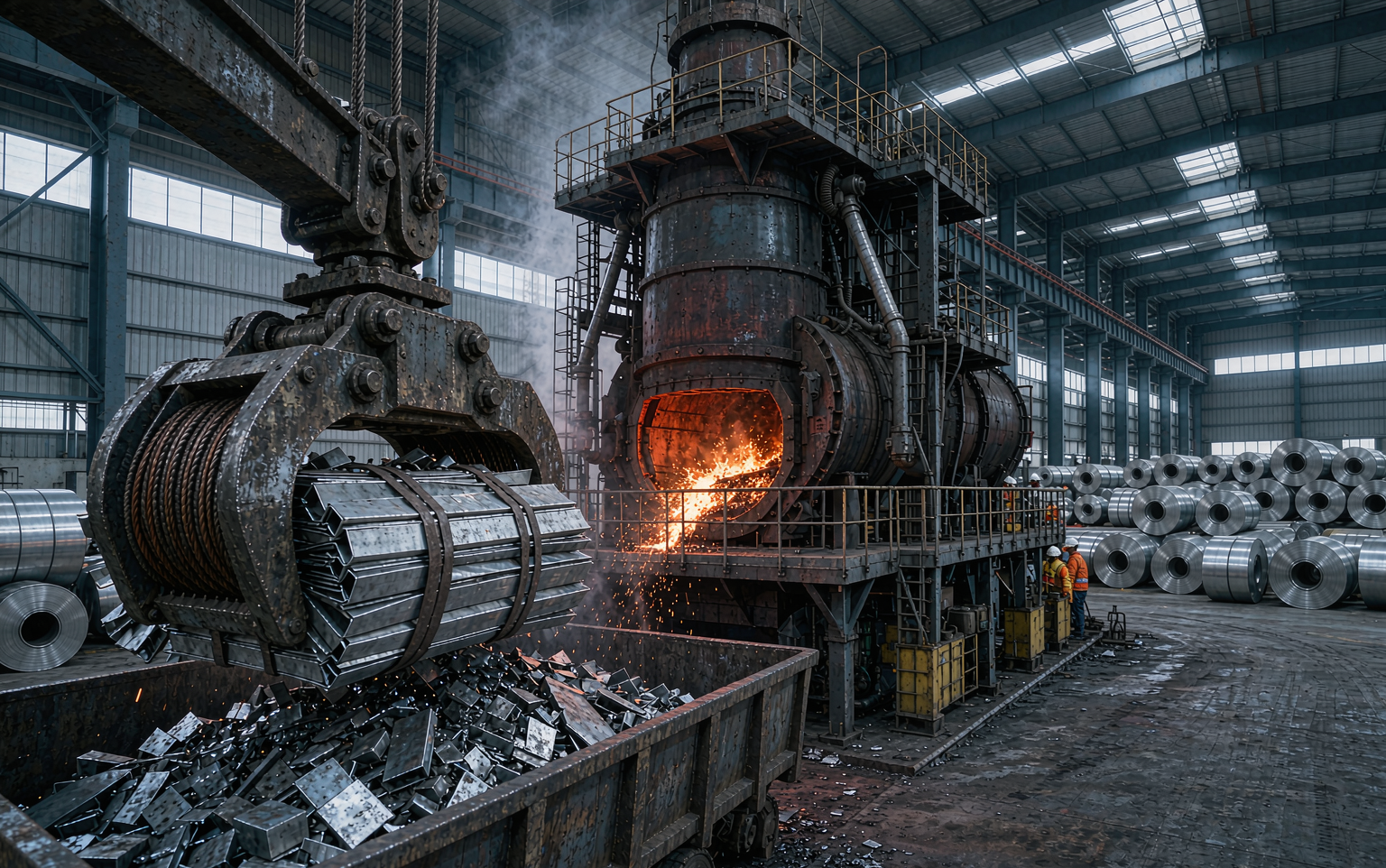
Every stainless steel quote you receive contains a variable that almost never appears on the quotation sheet: the mill's charge mix — the ratio of prime nickel units (nickel pig iron, ferrochrome) to recycled stainless scrap that goes into the electric arc furnace. This week's Chinese market data shows why that variable deserves a line item in your Q1 2027 procurement analysis.
This Week in Numbers (week ending 21 November 2026)
| Indicator | Level | Week-on-week |
|---|---|---|
| Wuxi 304 cold rolled, private mills, 4-ft base | RMB 13,750/t | −100 |
| Wuxi 304 hot rolled (NO.1) | RMB 13,500/t | −50 |
| Stainless futures SS2701 (SHFE) | RMB 13,870/t | −1.9% |
| SHFE nickel | RMB 118,950/t | −3.4% |
| 300-series social inventory (China) | 379,700 t | −4,400 t, third straight weekly year-low |
| High-nickel pig iron (10–12% Ni) | RMB 1,040 per Ni point | +5 |
| High-carbon ferrochrome (Inner Mongolia) | RMB 7,350–7,550 per 50 base t | Flat; December mill tenders expected lower |
| Ferro-molybdenum | ≈ RMB 332,500/t | +2,500 in early November |
The week's story was a rally that could not hold. Midweek, reports that Indonesia is preparing unified state control over nickel exports — on top of ministerial signals from 2 November that the 2027 RKAB ore quota will come in below the revised 2026 level of 290–300 million wet tonnes — pushed LME nickel toward USD 16,455/t and spot 304 briefly to RMB 14,000/t. By Thursday the futures board slumped, spot followed down RMB 200/t in a day, and the entire gain was surrendered. Raw material costs never loosened: high-Ni pig iron actually rose. What failed was not cost support — it was transactions.
That divergence — rigid prime-unit costs on one side, soft transaction prices on the other — is precisely the environment where a mill's scrap ratio becomes commercially decisive.
The Shadow Market Under Your Quote
Chinese yard prices for stainless scrap (Mysteel, mid-November 2026, Changzhou and Dainan yards):
| Scrap grade | Yard price | Alloy content |
|---|---|---|
| 304 new / laser plate | RMB 9,400–9,700/t | ≈8% Ni, 18% Cr |
| 304 industrial material | RMB 9,100–9,200/t | same, higher contamination |
| 316 new material | RMB 20,100–20,500/t | ≈10% Ni, 2% Mo, 16% Cr |
| 2205 duplex new material | RMB 20,000–20,500/t | 5% Ni, 3% Mo, 22% Cr |
| 2507 super duplex furnace material | RMB 22,200–22,500/t | 7% Ni, 4% Mo, 25% Cr |
| Pure molybdenum scrap | RMB 448/kg contained Mo | Mo units only |
Note how the yards quote duplex: 2507 is priced on a Ni-5 / Mo-3 basis with explicit per-unit adders for every additional point of nickel or molybdenum. Stainless scrap is not traded as "waste" — it is traded as a derivative of contained nickel and molybdenum units.
What One Tonne of 304 Scrap Is Actually Worth
Take one tonne of clean 304 new scrap at roughly RMB 9,500/t. It carries about 8 kg of nickel and 180 kg of chromium. At this week's unit values:
- Nickel: 8 kg × ≈RMB 104/kg (the NPI implied value at RMB 1,040 per Ni point) ≈ RMB 8,300
- Chromium: 0.18 t × ≈RMB 14,800/t contained (high-carbon ferrochrome basis) ≈ RMB 2,700
That is roughly RMB 11,000/t of contained alloy value — yet the scrap sells near RMB 9,500. Ignoring yield losses, clean 304 scrap trades at a 13–15% discount to its own metal content. A mill charging a furnace with 60–80% scrap is buying nickel and chromium at a structural discount the prime-unit price index will never show you.
Molybdenum Is Where the Scrap Discount Bites Hardest
Ferro-molybdenum at RMB 332,500/t (60% Mo basis) implies ≈RMB 554 per contained kilogram — with European ferro-molybdenum holding near multi-year highs around USD 80–81/kg Mo in mid-November, up over 50% year-to-date. Molybdenum units in scrap, by contrast, clear near RMB 448/kg — roughly a 19% discount to ferro-molybdenum units.
This is why the 316 and duplex scrap lines in the table above look so expensive per tonne, yet remain cheap per contained unit: in a tonne of 2205 scrap, molybdenum alone represents about two-thirds of the contained alloy value. For buyers of 316L and duplex, the mill's ability to source Mo-bearing scrap is now a bigger cost lever than the nickel price on your Bloomberg screen.
The Specification Side: Residuals and Traceability
A high scrap ratio is not free money — it transfers three risks onto the purchase order if the specification does not manage them:
1. Residual elements. Scrap-charged heats carry higher tramp copper and, in 304, occasional molybdenum carry-over from sorted 316 scrap. For deep-drawing, hygienic and nuclear-adjacent applications, cap residuals explicitly (e.g. Cu ≤ 0.2–0.3% for forming-critical 304) rather than relying on the ASTM envelope.
2. Traceability. Under the EU steel import regime (Regulation 2026/1963), melt-and-pour declarations are already required, and from October 2027 heat numbers plus mill test certificates become mandatory for customs clearance. Scrap-heavy production chains must prove single-heat integrity — blended or re-melted material without heat-level documentation will not clear.
3. Carbon accounting. Under the EU CBAM definitive regime (live since 1 January 2026, first declarations due 30 September 2027), purchased scrap is counted as having zero embedded emissions. A documented recycled-content percentage is therefore not a marketing line — it is a quantifiable reduction in your future CBAM liability.
Five Questions to Add to Your RFQ
1. What was the prime-to-scrap charge ratio for heats supplied against this contract, and is your offer priced off NPI unit values or scrap-linked costs?
2. What residual element caps (Cu, Mo carry-over in 304) do you guarantee, and what is the rejection protocol?
3. What is your scrap sourcing and grading system — radiation detection, spectrometer verification at the yard gate, single-heat integrity?
4. Can you issue the EU melt-and-pour declaration now, and are you prepared for heat-number + MTC requirements from October 2027?
5. Can you support a declared recycled-content percentage with input data for our CBAM reporting?
The Bottom Line
Nickel headlines will keep swinging — Indonesia's 2027 quota signal guarantees that. But the controllable variable in your 2027 stainless cost base is structural, not cyclical: it is the charge mix behind the heat you are buying. Buyers who specify scrap ratio, residual caps and traceability alongside price are not asking for favours — they are pricing the same metal the mills price, one discount layer deeper.
📞 Contact FSGood Steel immediately to obtain a quote or technical consultation:
📧 Email – jason@fsgoodsteel.com
📱 Phone – +86 18370137709
💬 WhatsApp - +86 18007093101
🌐 Website – www.fsgoodsteel.com