
Brushed Finish Direction and Anti-Fingerprint Coatings: Cost and Acceptance for Stainless Cabinetry
The Finish Is the First Thing a Buyer Sees — and the First Thing They Complain About
In stainless steel cabinetry, most warranty disputes are not about structure. They are about appearance: a door panel whose brushing direction does not match its neighbour, streaks that never wipe out because someone cleaned across the grain, or a fingerprint coating that wears off in the first six months. All three problems trace back to the same root — the brushed finish and its anti-fingerprint (AFP) coating were never properly specified, priced or inspected. This guide covers the two decisions that decide long-term satisfaction: grain direction and coating selection, with the cost drivers and acceptance tests for each.
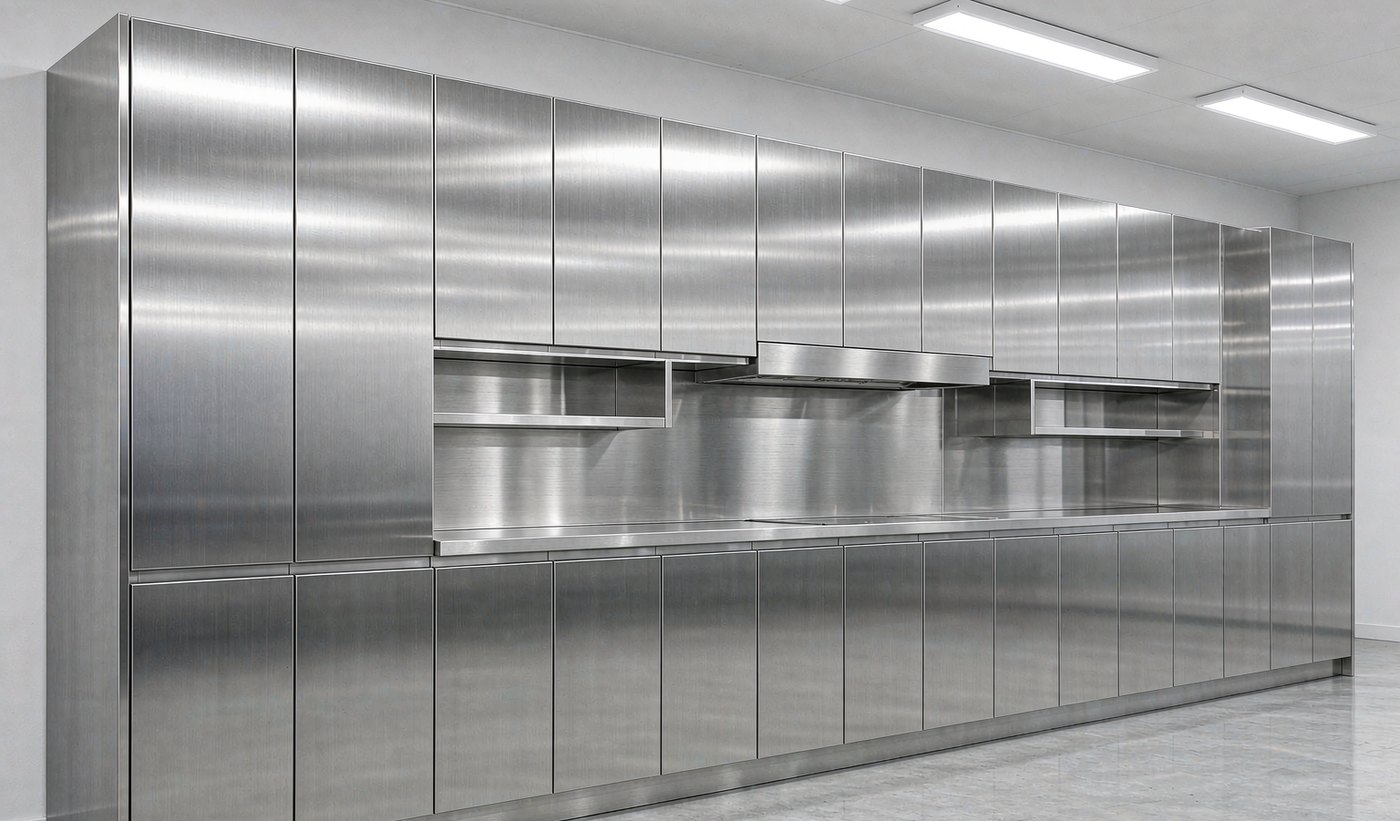
Grain Direction: Specification, Not Decoration
The two governing finish references are ASTM A480/480M, which defines the No. 4 finish (Ra typically 0.6–0.9 μm) for sheet, and EN 10088-2, which defines the 2J brushed finish and — critically — whether it is rolled longitudinal (along the coil) or transverse. Buying "No. 4" or "2J" alone is not a specification. A complete grain specification has four elements:
- Direction per component. On cabinet doors, grain conventionally runs vertical so that drips and cleaning strokes travel along the grain and residual streaking is less visible; on long continuous runs such as countertop splashes and plinths, horizontal grain keeps the highlight line continuous across the run. Mixing directions on visible adjacent surfaces is the single most common factory error.
- Consistency across panels. Hairline grain must be uniform in darkness and pitch across every panel in the kitchen. Panels brushed on different machines, or with worn abrasive belts, show as a patchwork under raking light — the classic "zebra cabinet" complaint.
- Edge-to-edge continuity. Where two panels meet, the grain must align in both direction and pitch. This requires brushing after cutting on panels cut from different coil positions, not just buying "brushed coil".
- Damage behaviour. Scratches run in the direction of the grain on doors handled daily; a vertical grain hides them, a cross-grain scratch stands out permanently. Specify grain direction with door orientation and user traffic in mind, not only aesthetics.
Verify the surface with a portable Ra meter per ISO 4287/4288 at three points per panel against an agreed Ra window — for a No. 4 cabinet door face, 0.4–0.9 μm is a workable acceptance band — and inspect under diffuse light at 1 m before packing.
Anti-Fingerprint Coatings: What They Are
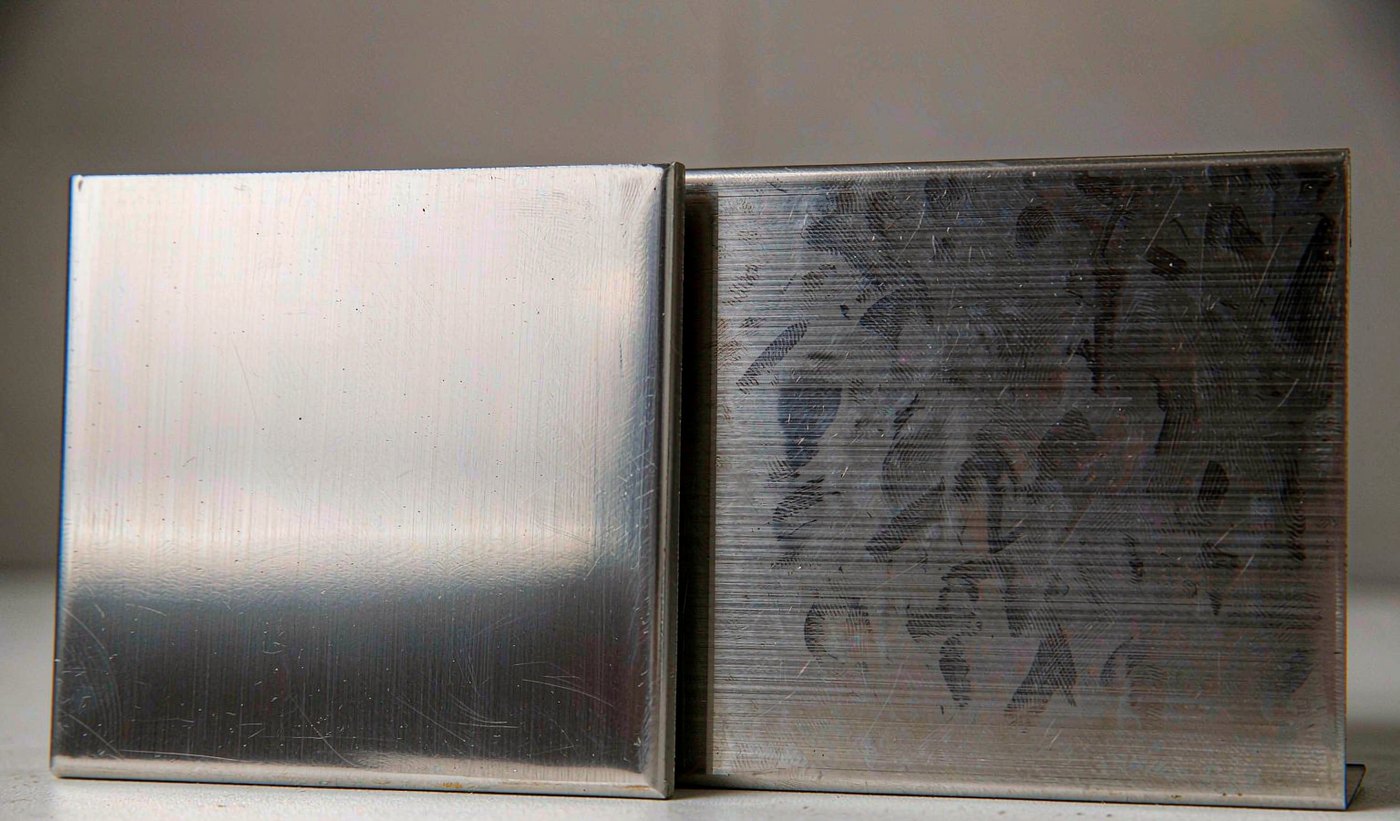
An AFP coating is a transparent polymer film — typically 2–5 μm, silicone- or fluoropolymer-based — applied over the brushed surface to reduce surface energy so that skin oils and water do not wet into the grain valleys. The practical benefits are real but specific:
- Fingerprints and water marks become far less visible and wipe off dry, without cleaner.
- The coating slightly deepens the satin lustre, which some markets prefer and others read as "not raw steel" — confirm the visual target with a coated sample before mass production.
- It does not make the surface scratch-proof; hardness is typically pencil H–2H (ASTM D3363). Scratching through the film exposes bare steel that will then show every mark.
Coating quality is verified on four axes: adhesion (ASTM D3359 cross-cut, accept Class 4B or better), abrasion life (Taber test per ASTM D4060 with a stated wheel, load and cycle count), corrosion of the coated surface (ASTM B117 salt spray, typically 240–500 h with no blistering or creepage at scribes), and stain behaviour — a standardized artificial-fingerprint rub test with defined synthetic sebum, number of rub cycles and post-test appearance grade. Any supplier who cannot produce raw test reports for the exact film system is selling a claim, not a coating.
What Actually Drives the Cost
AFP adds real money, and knowing where the money goes prevents both over-buying and silent substitutions:
- Where it is applied. Coil pre-coating at the mill is the most economical and most consistent route; post-brushing and coating of cut panels costs more per square metre and introduces batch variation. Ask which route the quote is based on.
- Coverage. One-side coating (visible faces only) is the normal cabinet specification. Coating both sides adds cost with no benefit on concealed faces — decline it unless the parts are seen from both sides.
- Indicative premium. As an order-of-magnitude reference, AFP-coated hairline coil is commonly quoted in the region of a 15–30% premium over equivalent uncoated material, depending on film system, batch size and whether the coater is the mill itself or a toll processor. Treat these as indicative market ranges and benchmark against two quotes — absolute numbers move with nickel surcharges and coil width.
- Total-cost view. AFP costs more per panel but reduces after-sales cleaning complaints and replacement claims on visible kitchen fronts. On high-touch doors and splashbacks it usually pays for itself; on internal carcass surfaces it is wasted money — split the bill of materials instead of coating everything.
Acceptance Checklist Before You Sign Off
- Grain direction drawing. One drawing showing grain direction for every visible part — doors, drawers, splashbacks, plinths — signed by both parties. No production without it.
- Ra window and measurement points. Agreed Ra band per finish class, measured per ISO 4287/4288 on a defined sampling plan (e.g. 3 points per panel, 10% of lot).
- Golden samples. Retained coated and uncoated reference panels from the actual production coil, stored at both the factory and the buyer's QC desk.
- Coating reports by film system. D3359 adhesion class, D4060 abrasion cycles, B117 hours, and the fingerprint rub protocol — by exact film name and batch, not "nano coating available".
- Cleaning instructions in the box. Wipe along the grain, no chloride-containing or abrasive cleaners, consistent with ASTM A380 practice for finished stainless surfaces. Half of "coating failure" complaints are cleaner damage.
Specified this way, the brushed finish stays uniform and the coating survives its warranty — which is exactly what a buyer sees, and pays for.
📞 Contact FSGood Steel immediately to obtain a quote or technical consultation:
📧 Email – jason@fsgoodsteel.com
📱 Phone – +86 18370137709
💬 WhatsApp - +86 18007093101
🌐 Website – www.fsgoodsteel.com