
Stainless Steel Cabinet Drawer Slides and Pull-Out Baskets: Load Ratings and Standards Explained
Why the Slide, Not the Drawer, Decides Service Life
In a stainless steel cabinet, the drawer box and the pull-out basket almost never fail — the running gear underneath them does. Field complaints such as sagging drawers, intermittent soft-close behavior, and jammed telescopic rails trace back to one of three causes in most cases: an undersized load class, a mismatch between the test condition and the real installation, or corrosion of the ball raceway in a humid or chloride-rich environment. This guide explains the two governing standards — ANSI/BHMA A156.9 in North America and EN 15338 in Europe — and how to convert a published load rating into a specification that survives real kitchens.
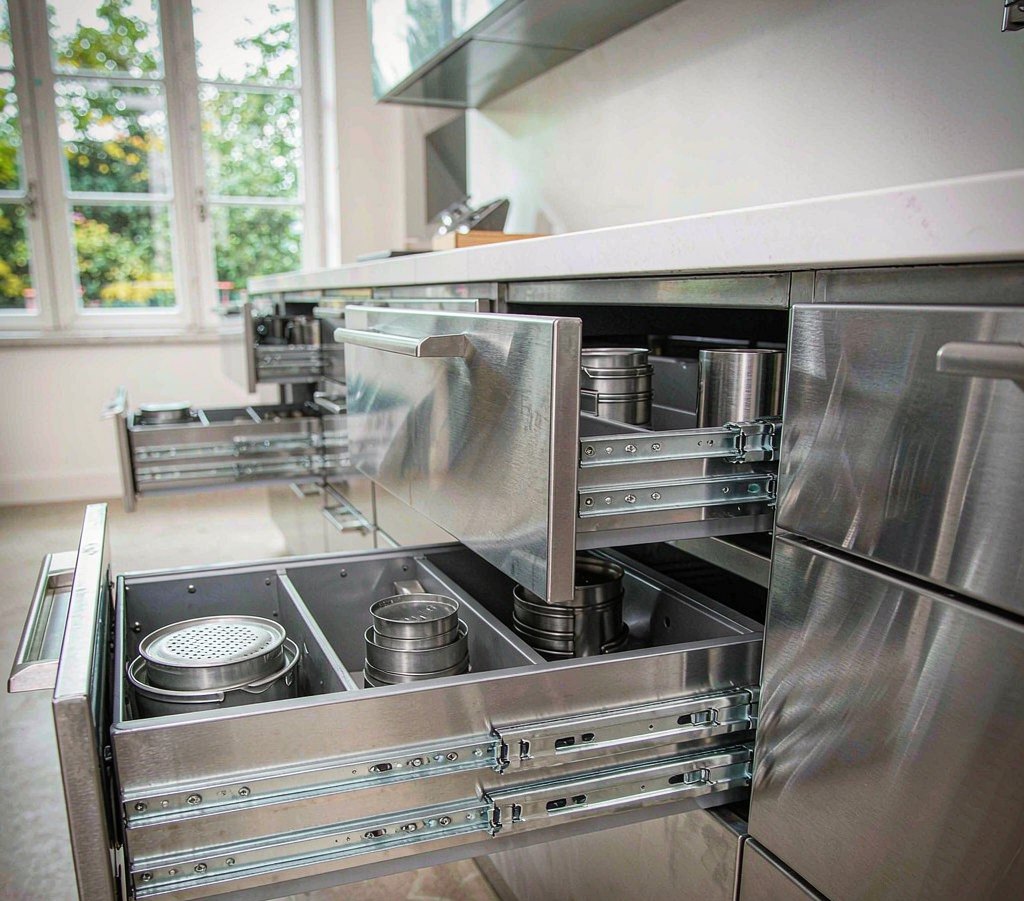
ANSI/BHMA A156.9: Grades, Cycles and Static Loads
ANSI/BHMA A156.9-2020 is the North American performance standard for cabinet hardware, covering hinges, pulls, catches, shelf supports and drawer slides. Most products are graded 1 (highest), 2 and 3, with an additional 1HD (heavy duty) grade for slides. For drawer slides, the key requirements are:
- Cycle life: Grade 1 = 50,000 open-close cycles, Grade 2 = 35,000, Grade 3 = 25,000. The cycle test runs at 10 cycles per minute with a 50 lb (22.7 kg) load in the drawer, which must remain operable afterward.
- Static edge load: after cycling, a 75 lb (33.4 kg) load is applied on the center line of the drawer front at half travel for one minute (Grade 1 and 1HD); the drawer must not suddenly collapse. Grade 1HD additionally carries a 100 lb (45 kg) static load requirement.
- Opening force: a Grade 1 slide must open with no more than 50 N (11.2 lbf) of force, ensuring smooth travel under load.
- Disconnect: heavy-duty (1HD) slides must include a positive disconnect device requiring manual release before the drawer can be removed.
One caution when reading datasheets: the A156.9 numbers are pass thresholds, not working capacities. A slide marked "A156.9 Grade 1" has survived 50,000 test cycles at 50 lb — it does not mean 50 lb is the manufacturer's rated load. Premium systems publish their own higher figures, for example undermount platforms rated at 100–132 lb (45–60 kg) depending on model and drawer width.
EN 15338: The European Framework for Extension Elements
European specification is anchored on DIN EN 15338 — Strength and durability of extension elements and their components — which governs drawer runners, telescopic slides and pull-out systems. The standard defines load classes by the declared dynamic capacity (commonly 10, 25, 40 and 70 kg tiers), and verifies each class through loaded cycle testing. Drawer hinges are covered separately by EN 15570.
Two European data points worth quoting in a specification:
- Major fitting makers publish cycle references per product family — 80,000 and even 100,000 opening cycles for premium drawer systems — always tied to a specific article number and load class, not to the brand in general.
- Corrosion resistance of hardware is verified by a 72-hour condensation water test under DIN EN ISO 6270, a different regime from salt spray and one that better reflects a humid kitchen or coastal installation.
What Actually Determines a Slide's Real Capacity
A load rating is only valid within the conditions of its test. Four variables change it:
- Reference length. Ratings are quoted at a reference runner length — 500 mm in European practice, 18 in (457 mm) in common US usage. The same 45 mm-wide slide rated 100 lb (45 kg) at 18 in may derate to roughly 60 lb (27 kg) at 28 in, because a fully extended drawer applies leverage on the rear third of the runner and its fixing screws.
- Slide width and steel thickness. Common side-mount tiers run approximately 45 mm ≈ 100 lb, 53 mm ≈ 250 lb and 76 mm ≈ 500 lb (11/113/227 kg), built on steel profiles of roughly 1.0–1.2 mm, 1.8–2.0 mm and 2.5 mm respectively. Heavy-duty slides for larder units and workshop cabinets (80–250 kg) use 2.0–2.5 mm stock.
- Mounting orientation. Flat-mounting a slide under the drawer box instead of side-mounting can reduce effective capacity by 60–75%, since the raceway geometry is designed to carry load laterally.
- Static vs dynamic. The dynamic rating (in motion, fully extended) is always lower and is the only value that matters for specification. Some suppliers quote the static figure; if a datasheet does not say which, assume the lower number.
The Stainless Steel Specifics: Baskets, Wire and Corrosion
In stainless cabinetry the running hardware is only half the moving system — the pull-out basket rides on it. Basket construction matters as much as the slide rating:
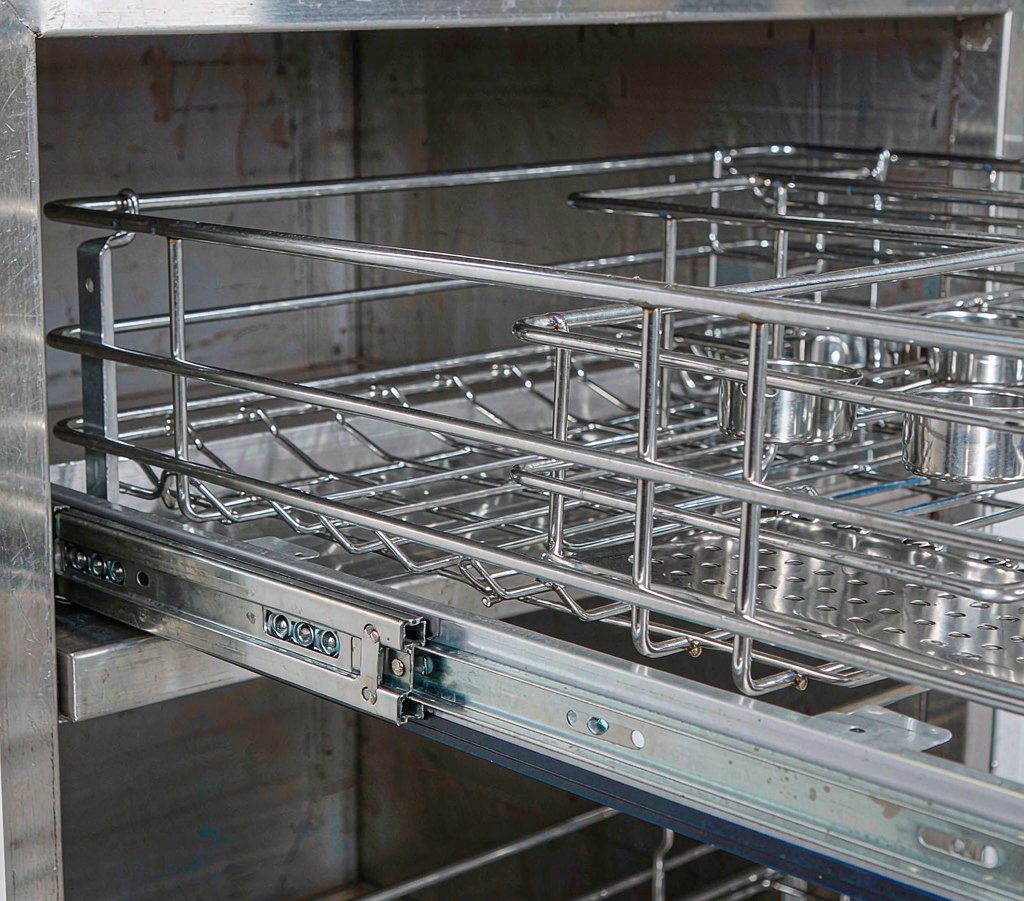
- Wire grade and welds. Quality baskets use 304 (18-8) stainless wire with fusion-welded intersections, then passivated per ASTM A967 to restore the chromium oxide layer after welding. In coastal or chlorinated environments, specify 316 for both baskets and exposed slide components.
- Hardware material codes. Within the BHMA numbering system, the material digit identifies construction — code 5 denotes 300-series stainless steel — so a stainless slide designation can be verified from its part number alone.
- Finish and corrosion tests. A156.9 verifies finishes through salt spray exposure (16 h for Class A exposed hardware, shorter for concealed classes), while the European route uses the 72 h condensation test of EN ISO 6270. For a humid export market, request the specific corrosion result for the exact slide model, not a family-level claim.
- Load transfer. A wire basket concentrates load at its rail brackets rather than spreading it like a drawer box. Verify that the slide's rated load includes the basket's tare weight plus contents, and that the basket brackets do not overload the front end of the runner.
Specifying for the Project: A Practical Checklist
Translating standards into a purchase specification takes five lines:
- Size the load honestly. Sum the tare weight of the drawer or basket, the front panel, and the maximum realistic contents. Add a safety factor of 1.5–2×; for wide vanity drawers (36 in / 900 mm and above) treat 2× as non-negotiable.
- Name the standard, grade and load class. "A156.9 Grade 1" or "EN 15338, 40 kg class" — never "heavy duty" or "imported soft close" as the entire specification.
- Confirm the reference length. Require the rating at the actual runner length being ordered, not a 500 mm or 18 in nominal figure.
- Request the test report by model. Ask for the dynamic load test curve for the exact slide article and length. A factory that cannot produce raw cycle data promptly is a sourcing risk regardless of price.
- Match corrosion testing to the destination market. 72 h condensation per EN ISO 6270 for humid regions, salt spray data for coastal and chlorinated installations, and passivation certificates for 304/316 basket wire.
Specified this way, the slide outlasts the cabinet — which is the only outcome that matters over a 15-year kitchen life cycle.
📞 Contact FSGood Steel immediately to obtain a quote or technical consultation:
📧 Email – jason@fsgoodsteel.com
📱 Phone – +86 18370137709
💬 WhatsApp - +86 18007093101
🌐 Website – www.fsgoodsteel.com