
Fire-Rated Stainless Steel Doors: What Importers and Contractors Should Verify Before Ordering
Fire-Rated Stainless Steel Doors: What Importers and Contractors Should Verify Before Ordering
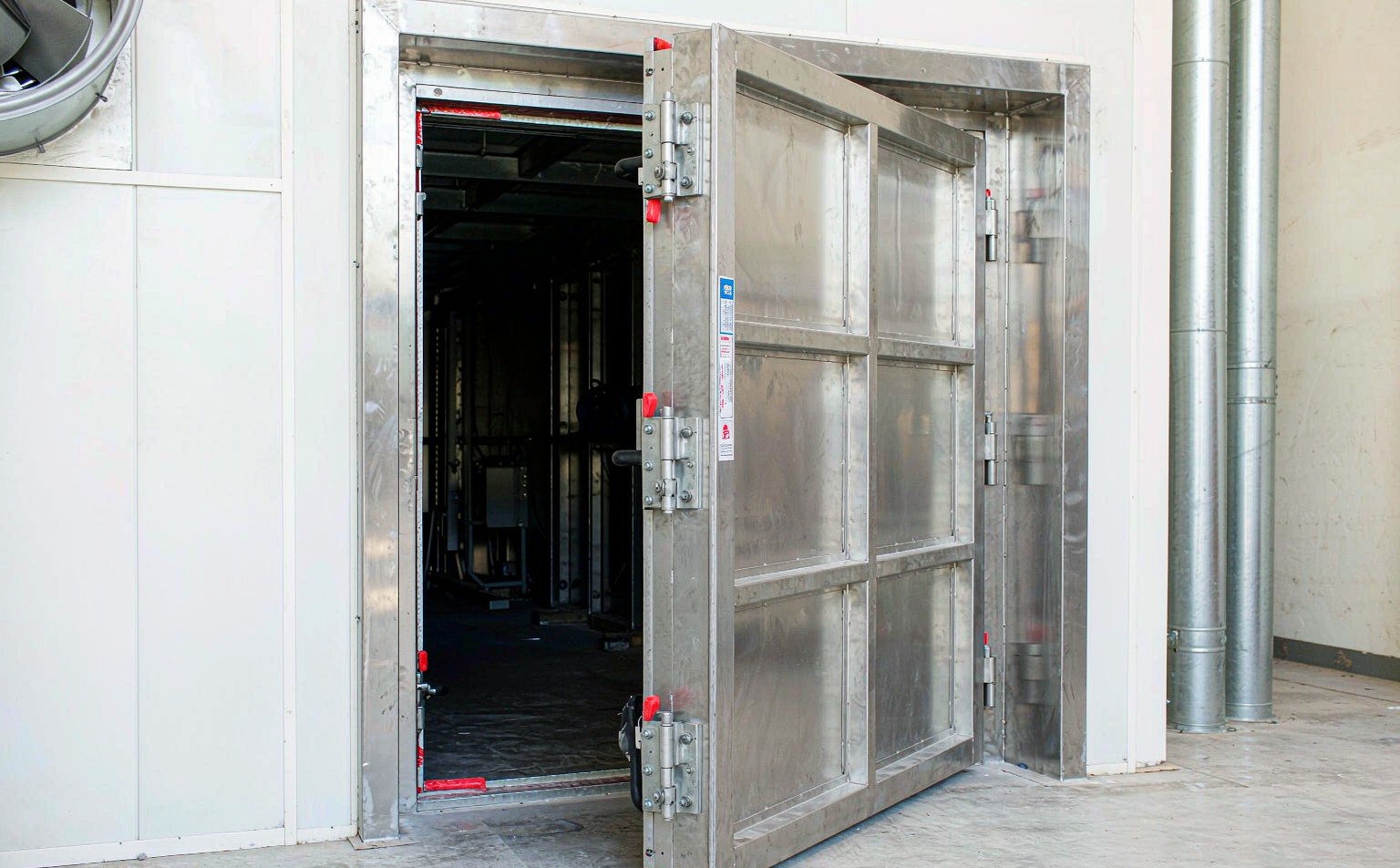
In door procurement, "fire-rated" is the most expensive adjective on the quotation - and the least verifiable at the moment of delivery. A stainless steel door that looks identical to a certified assembly can differ in core material, seal type, hinge backing or frame anchorage in ways that are invisible after painting, packing and container loading. By the time the difference matters, it is a building inspector, not a buyer, who finds it.
This guide explains what a fire rating actually attaches to, which test standards exist, what a valid certificate chain looks like, and the specific verification points for stainless steel door assemblies. It is written for importers, contractors and project consultants specifying doors for commercial, residential and public buildings.
A rating belongs to an assembly, not to a door leaf
The single most common misunderstanding in fire door purchasing is treating the rating as a property of the leaf. It is not. A fire door rating is a test result for a complete installed assembly: the leaf, the frame, the hinges, the lock and latch, the closer, any glazing and its beads, and the intumescent and smoke seals, all in a defined wall construction with defined fixings.
This has immediate commercial consequences. A leaf tested at 60 minutes does not give you a 60-minute door. Swap the closer, enlarge the vision panel, change the frame material or install into a different wall type, and the test evidence no longer describes your door. Reputable manufacturers manage this through a documented range of permitted variants; the rest manage it through optimistic brochures.
The test standards landscape
Different markets test fire doors differently, and the differences are substantial enough that a report from one regime does not automatically satisfy another. The table below summarizes the frameworks buyers encounter most often.
| Regime | Test standard | Classification | Notes for buyers |
|---|---|---|---|
| Europe | EN 1634-1 | EN 13501-2: E, EW, EI, EIS with durations (EI30, EI60...) | E = integrity only; EW = integrity + limited radiation; EI = integrity + insulation. EI requires the unexposed face to stay below a temperature rise limit, which is a materially harder test |
| United Kingdom (legacy, still referenced) | BS 476 part 22 | Integrity and insulation in minutes | Often paired with EN 1634 evidence on dual-market projects; check which one the spec actually invokes |
| North America | UL 10B / UL 10C, NFPA 252 | 20, 45, 60, 90, 180 minutes etc. | UL 10B is neutral-pressure, UL 10C positive-pressure; many North American authorities require positive-pressure evidence, so a 10B report alone may not comply |
| Australia | AS 1530.4 | Integrity and insulation periods | Specified with the National Construction Code; has its own field-of-application rules |
Two vocabulary points prevent most cross-border confusion. First, integrity and insulation are different achievements: a door can hold back flames for an hour while its unexposed face becomes hot enough to ignite paper on the other side. When a specification says EI60, the insulation requirement is included - and hardware and core design must respect it. Second, smoke control is a separate performance with separate testing; a fire rating alone says nothing about leakage at ambient temperature.
Test report, field of application and certification: three different documents
Buyers are frequently shown a test report and told the door is "certified". The chain that actually supports a claim has three distinct links:
- The test report documents one assembly tested once, in one wall, at one laboratory. It is evidence, but evidence for a specific configuration.
- The field of application (or assessment) extends the tested result to a defined family of variants - different widths and heights, wall types, glazing sizes, hardware sets - within documented limits. This is the document that tells you whether your actual door size is covered.
- Third-party certification ties the factory's ongoing production to the tested design: initial type testing, factory production control, periodic audit testing of samples taken from production, and a certification body that can be contacted. A label or plug on the door identifies the certified product and its rating.
A supplier who can produce all three documents for the exact configuration you are buying is making a verifiable claim. A supplier who produces only a test report - possibly for a different size, from years ago - is making a story. On public and commercial buildings, most authorities and insurers expect the third link, not just the first.
What is inside a fire-rated stainless steel door
Stainless steel is an excellent cladding material for fire doors: it does not burn, it resists corrosion and cleaning chemicals, and it survives high-traffic environments. But the stainless skins are not what provide the rating. The engineering is in the core and the details:
- Core. Fire-rated leaves use non-combustible cores - vermiculite or mineral-based panels are common - often combined with structural stiffening. The core thickness, coverage and fixing pattern are part of the tested design; substituting a lighter core is the classic silent downgrade.
- Edge construction and intumescent seals. Intumescent seals expand under heat and close the leaf-to-frame gap. Their position - in the leaf edge or the frame rebate - their size and their coverage are all test-specific. Seals must be continuous, correctly jointed and undamaged on site.
- Frame. The frame is usually the weak link in imported assemblies. Gauge, profile, anchorage type and the wall it is fixed to all belong to the tested configuration. A frame shipped loose and site-modified is an untested frame.
- Hardware. Hinges, locks, closers and panic hardware must be from the tested or assessed hardware schedule, and hinges for fire doors carry their own fire test evidence. A stainless door with beautiful decorative hardware that was never part of any test is an untested door.
- Glazing. Vision panels use fire-rated glazing systems - glass plus beads plus gaskets as a tested unit. Enlarging an aperture even slightly can void the evidence, so glazing size limits in the field of application deserve close reading.
The verification mistakes we see most often
| What buyers accept | Why it is a risk | What to request instead |
|---|---|---|
| A test report without the classification report | The pass/fail numbers need formal classification to be comparable across markets | Test report plus EN 13501-2 classification (or the equivalent in the target regime) |
| A report for a different door size | Size, wall type and hardware are part of the tested design | Field of application covering your exact size, wall and hardware set |
| "Certified" claimed with no certifier named | Uncertified claims cannot be audited and fail inspections | Named certification body, certificate number, and the label fitted to the door |
| Hardware chosen freely for aesthetics | Unlisted hardware is a common cause of failed inspections | Hardware schedule matched to the assessment, with hinge fire evidence |
| Frames site-welded or modified on installation | Modification takes the assembly outside its evidence | Installation instructions, approved fixings, and installer sign-off |
Document checklist for an order
Requesting this list at quotation stage costs nothing and filters suppliers efficiently, because a manufacturer with real fire-door competence produces all of it without effort:
- Test report and classification report for the assembly, naming the laboratory and date
- Field of application or extended assessment covering your sizes, wall types and hardware
- Third-party certificate with the certification body, number and validity
- Hardware schedule with fire evidence for hinges, locks and closers
- Glazing system evidence where vision panels are included
- Installation instructions including frame anchorage for your wall type
- Sample of the door label or identification plug and its placement
One more point worth making to project teams: fire doors also need maintenance and periodic inspection under most building codes, and closers and seals are the parts that fail first in service. Specifying hardware that is available locally is not only a procurement preference - it is part of keeping the door compliant for its service life.
Frequently asked questions
Is a 60-minute stainless steel door fire-rated for 60 minutes in any wall?
No. The rating applies to the tested assembly in the tested wall construction, extended only through a documented field of application. Confirm your wall type is included before ordering.
What is the difference between EI60 and E60?
E60 requires integrity only - the door holds back flames. EI60 additionally requires insulation: the unexposed face must stay below a defined temperature rise. EI is the harder requirement and usually needs a more substantial core and hardware specification.
Can one set of certificates serve Europe and North America?
Not automatically. EN 1634-1 and UL/NFPA testing differ in pressure conditions and acceptance criteria. Dual-market projects normally require evidence under each regime, or a specification that explicitly accepts one.
Does the stainless steel surface affect the fire rating?
The skins are non-combustible either way, but leaf construction, core, seals and hardware - not the surface finish - decide the rating. Finish selection can proceed on durability and aesthetics grounds, provided the tested construction underneath is unchanged.
Can we buy fire doors without certification if we have a test report?
Some jurisdictions allow it; most public and commercial projects do not. Even where it is legal, third-party certification is what a building inspector, insurer or consultant will look for, and it is the manufacturer's cost to provide, not yours.
Send us the door schedule - sizes, ratings, wall types, hardware requirements and the market you are building in. We will confirm which configurations we can support with test evidence and third-party certification, state plainly which ones fall outside the field of application, and quote with the full document package included.
📞 Contact FSGood Steel immediately to obtain a quote or technical consultation:
📧 Email – jason@fsgoodsteel.com
📱 Phone – +86 18370137709
💬 WhatsApp - +86 18007093101
🌐 Website – www.fsgoodsteel.com