
Stainless Steel Door Hardware: Hinges, Locks and Installation Tolerances That Decide Long-Term Performance
When a Door Fails, It Is Rarely the Sheet
When buyers evaluate a stainless steel door, most of the attention goes to the visible surface: the grade of the sheet, the brush direction, the finish. Yet the complaints that reach a door manufacturer two or three years after handover are almost never about the leaf itself. They are about a hinge that has begun to sag, a latch that needs to be lifted before it engages, or a gap that has opened unevenly along the latch side. The leaf is a passive panel; the hardware and the way it was installed are working parts. They decide how the door performs after ten years of service.
This guide covers the three areas that matter most when specifying or inspecting a stainless steel door: hinge selection, lock and handle standards, and the installation tolerances that are easy to skip on site and expensive to correct afterwards.
Hinge Selection: Start with the Leaf Weight
A hinge is sized by the mass it must carry and the number of cycles it must survive. The first step is estimating the door leaf weight. A 900 × 2100 mm leaf in 304 stainless steel with 0.9–1.2 mm skins and a honeycomb or foam infill typically falls between 35 and 60 kg; a fully welded leaf with heavier gauges and a continuous frame can exceed that considerably. Hardware specified for a 40 kg timber door will not survive on a 60 kg stainless leaf.
In markets that follow European practice, hinge duty is classified under EN 1935, which grades single-axis hinges by use category, test cycles, door mass and moment. The highest use category (category 4) is tested for 200,000 operating cycles with test door masses up to 160 kg. Specifying a hinge whose declared mass and cycle class meet or exceed the calculated leaf weight is the single most effective way to prevent sag-related complaints. Ball-bearing butt hinges are the default for stainless doors because the bearing races keep turning friction low across a long service life; plain pin hinges wear faster under heavy leaves.

Three further points are frequently missed:
- Number of hinges. Three hinges are standard for a 2100 mm leaf. As a common rule of practice, add one more hinge for each additional 300 mm of leaf height beyond that, and add hinges or upgrade the class when the calculated mass approaches the hinge rating.
- Material match. A 316 coastal-specification door fitted with 304 hinges creates a galvanic and corrosion mismatch at the most fatigue-loaded joint in the door. Hardware material should match the environment specification of the leaf, and passivation of machined hinge parts in line with ASTM A967 is a reasonable acceptance requirement.
- Reinforcement and screws. Hinge reinforcements in the leaf and frame should receive machine screws with full thread engagement. Partially engaged or oversized pilot holes are the leading cause of hinge pull-out on heavy leaves.
Locks, Cylinders and Handles: Which Standard Applies
For European-specification projects, the relevant product standards are EN 12209 for mechanically operated locks, EN 1303 for cylinder keys and cylinders, and EN 1906 for lever handles and knob furniture. In North American practice, the ANSI/BHMA A156 series covers the same ground, with Grade 1 denoting the heaviest commercial duty — the appropriate class for entrance doors in high-traffic buildings. The practical requirement for a buyer is simple: hardware should carry a declared classification against one of these standards, and the classification should match the traffic expectation of the opening. A storage-room door and a building entrance should not carry the same lock class.
Two alignment details determine whether a lock feels right for the whole life of the door. The strike must line up with the latch within roughly a millimetre; an offset strike forces the latch to rub, which is felt as a gritty action and eventually becomes a warranty claim. And the mortise lock faceplate should sit flush with the lock edge within about 0.5 mm — proud faceplates scrape the frame rebate, recessed ones collect dirt.
Installation Tolerances: The Part That Gets Skipped
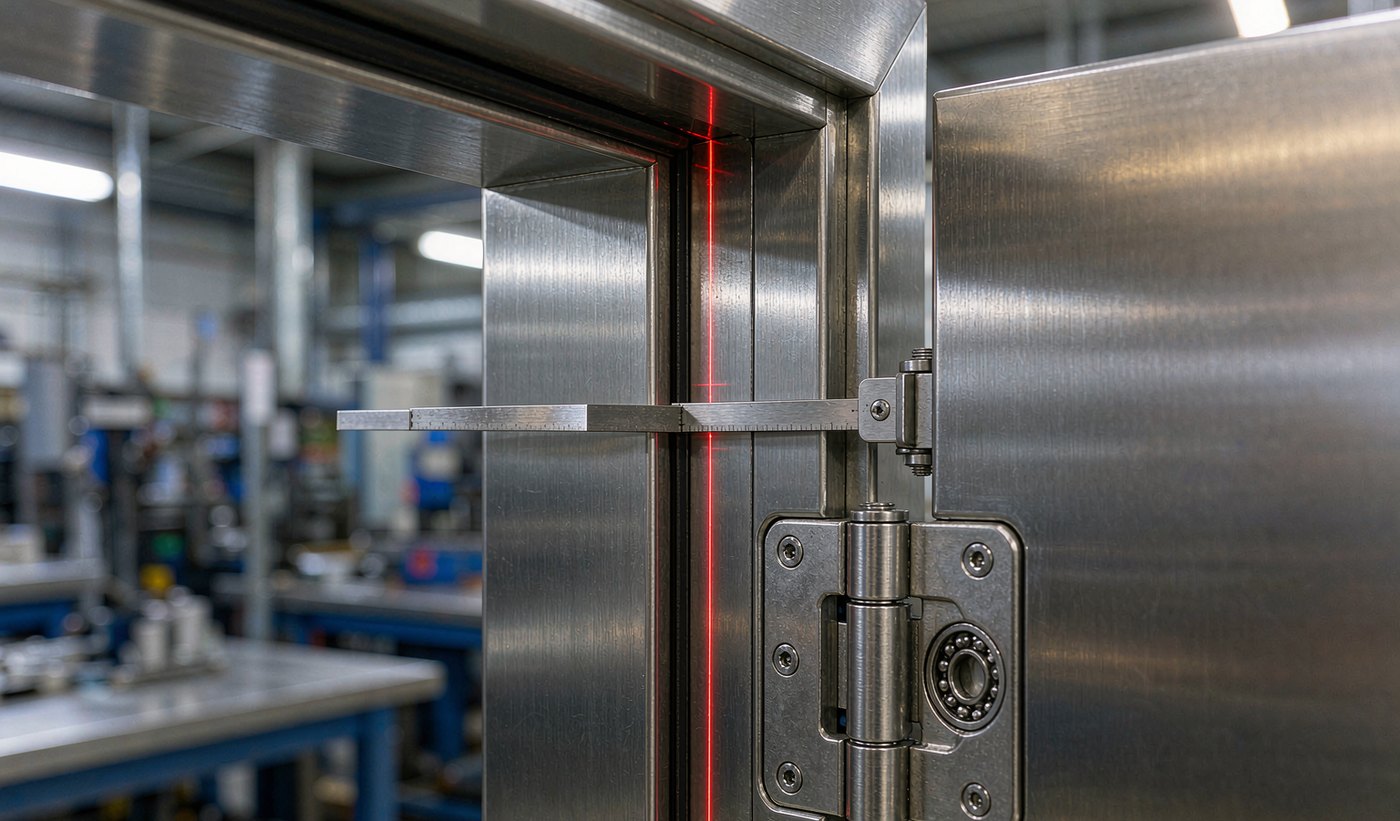
Factory quality is wasted if the frame goes in out of plumb. Before the leaf is even hung, the frame must be plumb, level and square; a twisted frame cannot be compensated by hinge adjustment. The leaf-to-frame gaps are the visible record of that work. Following common hollow-metal practice (SDI/HMMA guidance), typical values are:
- Hinge side: approximately 2–3 mm, uniform from top to bottom. A gap that widens toward the top means the hinge jamb is leaning.
- Latch side and head: approximately 3–5 mm. More than that and the latch engagement shortens; less and the leaf binds when the finish or hardware swells slightly.
- Bottom clearance: 6–13 mm depending on the finished floor and any threshold or weather seal, set with the finish floor in place, not the screed.
Leaf warp is the other acceptance criterion worth writing into the purchase contract. For a standard leaf, a maximum warp of about 6.4 mm (1/4 in), measured with a straightedge and feeler wire on the diagonals, is the commonly accepted limit in hollow-metal practice. A leaf that passes this check at handover but is installed against an out-of-square frame will fail it within months.
Finally, the installation sequence matters. Shims — not bending the frame back with a crowbar — should correct alignment, because bending work-hardens and can crack the welds at the frame corners. Hinge screws should be tightened to a consistent torque in a cross pattern, and on heavy leaves a re-torque check after the first month of service, once the door has settled, catches 90% of future sag problems at zero cost.
A Practical Pre-Dispatch Checklist
For importers and contractors who receive doors in bulk, a short inspection routine before dispatch — or at the port — catches most of these issues:
- Confirm hinge class documentation against calculated leaf weight (EN 1935 or equivalent).
- Hang one sample door from each batch, measure the four gaps with feeler gauges, and cycle the lock 20 times.
- Check that the latch engages without lifting the handle and that the faceplate is flush.
- For coastal projects, verify hardware material certificates (316) and passivation records.
- Confirm spare hardware: a pair of hinges and one cylinder per container costs little and saves a freight claim.
Conclusion
A stainless steel door is a system: leaf, hinges, lock and frame geometry. The leaf grade gets the attention, but hinge class, lock certification and installation tolerances decide whether the door still closes smoothly in year ten. At Goodsteel, doors are supplied with hardware pre-fitted and gap-measured on jigs before packing, and hardware classes are declared against EN standards so buyers can verify them at their end. If you are planning a project and want the hardware specification reviewed against your leaf design, our engineering team can check it before you commit.
📞 Contact FSGood Steel immediately to obtain a quote or technical consultation:
📧 Email – jason@fsgoodsteel.com
📱 Phone – +86 18370137709
💬 WhatsApp - +86 18007093101
🌐 Website – www.fsgoodsteel.com