
Duplex 2205 for Stainless Steel Cabinets and Door Frames: When It Beats 304 and 316L
Why the Question Comes Up
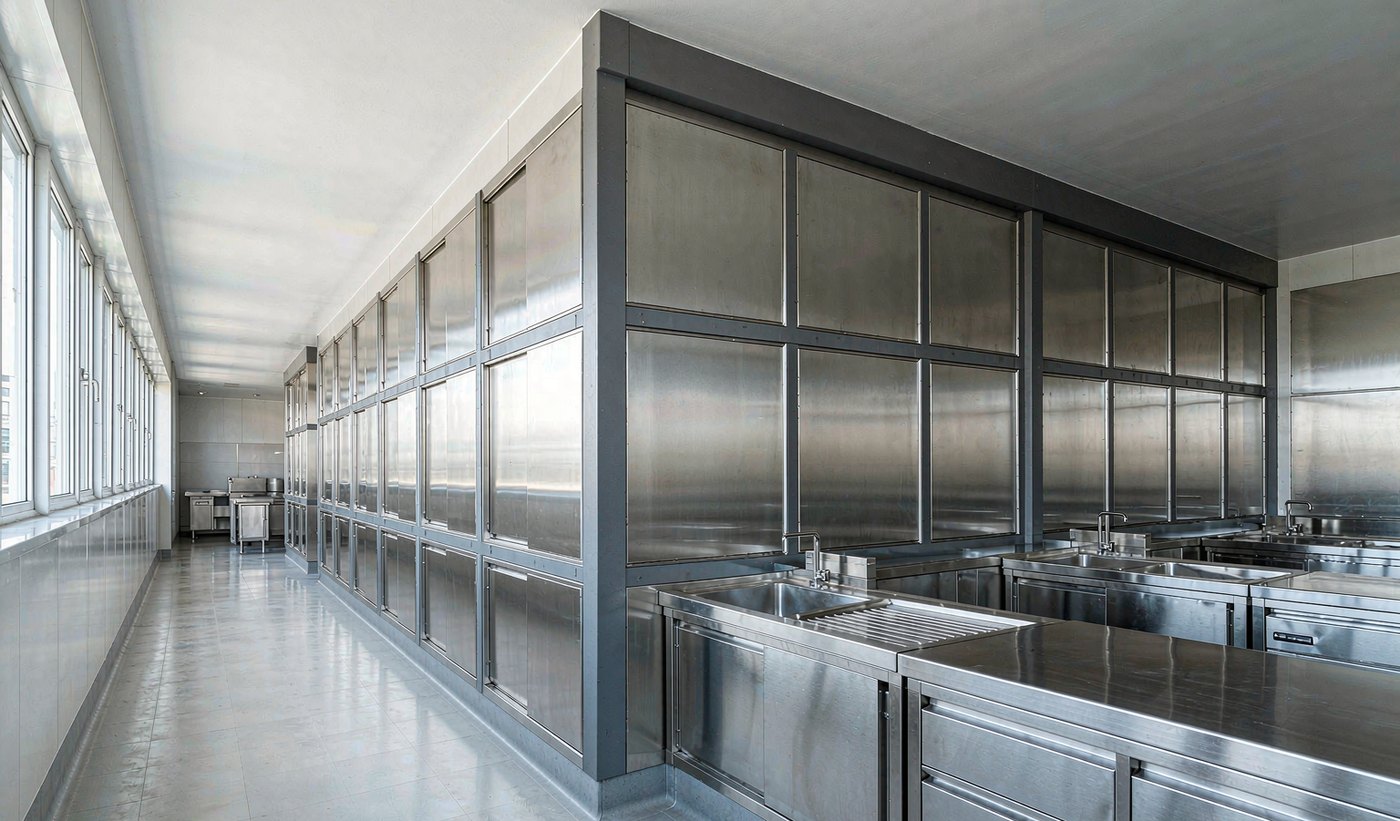
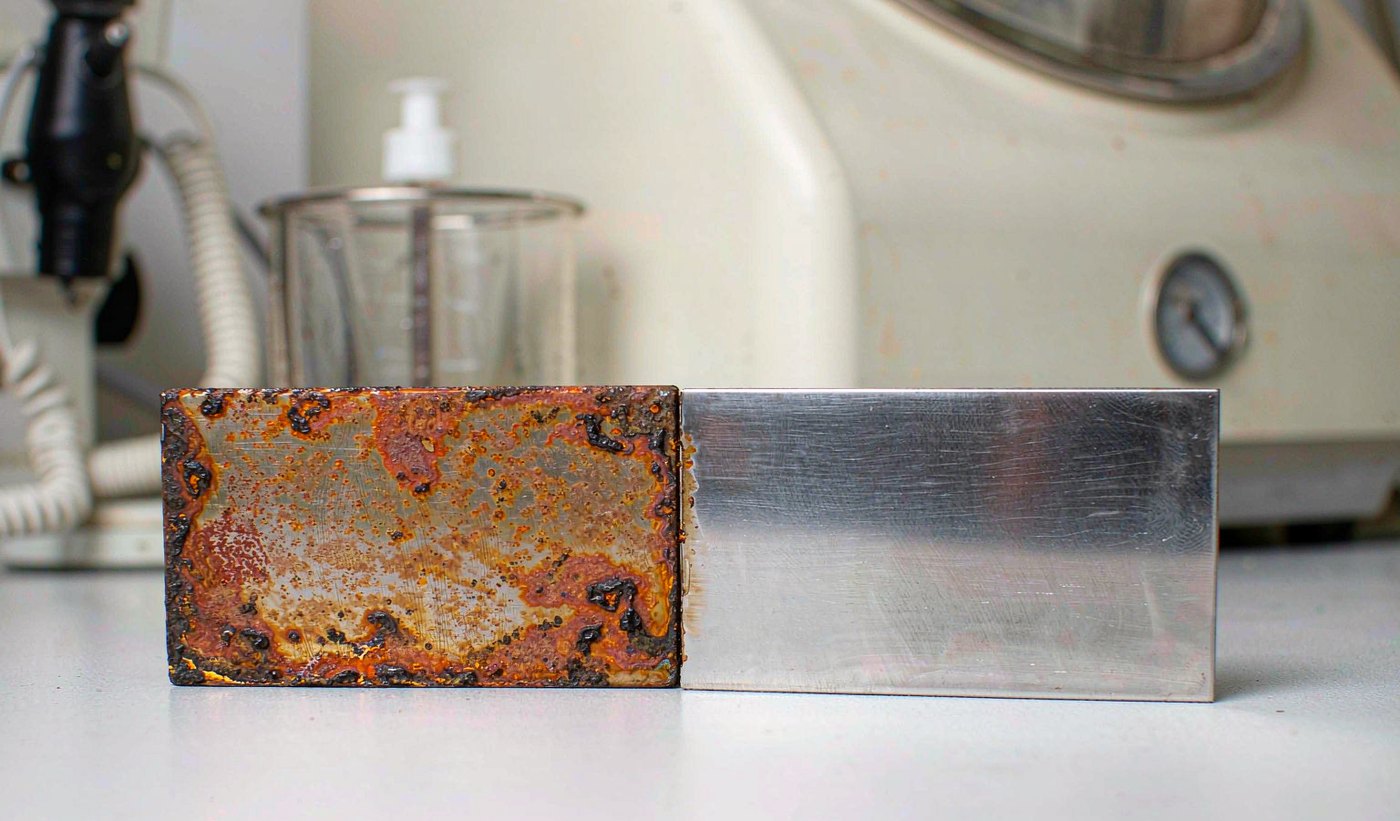
Most stainless steel cabinets and door frames are specified in 304 because it is cheap, available and perfectly adequate in dry inland air. The upgrade question appears the first time a project fails near the coast or in a wet process environment: tea-staining streaks down a hotel balcony door frame within a year of commissioning, rust bleeding from the welds of a seafood plant worktable, pits forming in the crevices where a cabinet door frame meets its mounting rail. The standard industry response is to step up to 316L — and in many cases that is the correct, economical answer. But 316L has real limits in chloride service, and there is a growing class of projects where the right material is neither 304 nor 316L but duplex 2205 (UNS S32205, EN 1.4462).
What 2205 Actually Is
Duplex 2205 is a two-phase stainless steel whose microstructure is roughly a 50/50 mix of austenite and ferrite. Its chemistry — approximately 22% chromium, 5% nickel, 3% molybdenum and 0.15–0.20% nitrogen — is engineered so that both phases coexist in balance after solution annealing. That balance delivers a combination neither pure-austenitic nor pure-ferritic grades can match:
- Pitting resistance. Using the standard PREN formula (%Cr + 3.3×%Mo + 16×%N), 2205 scores roughly 35, against about 24 for 316L and 18 for 304. In ferric chloride testing (ASTM G48 Method A), 2205 typically shows critical pitting temperatures of 35–40°C or higher, versus roughly 15–20°C for 316L. In practical terms: where 316L begins to pit in warm chloride solutions, 2205 still has margin.
- Crevice resistance. Cabinet and door assemblies are full of crevices — frame-to-wall gaps, hinge recesses, weld backing strips. Duplex 2205's critical crevice temperature sits well above 316L's, which matters because crevice corrosion, not free-surface pitting, is what usually kills cabinet hardware in coastal service.
- Stress-corrosion cracking resistance. Chloride stress-corrosion cracking (SCC) is the classic hidden failure of austenitic 304 and 316 in hot chloride environments — external cladding over a hot pipe line, a cabinet beside a dishwashing line, fastener pockets that hold salty water at 60°C or more. The ferrite phase in duplex makes 2205 dramatically more resistant to SCC than any 300-series grade.
- Twice the strength. 2205's minimum yield strength is about 450 MPa — more than double 304's 205 MPa minimum — with a minimum tensile strength around 620 MPa. It is magnetic, noticeably harder, and stiffer in practice.
The Strength Advantage Is an Economic Argument
The yield-strength doubling is not just a datasheet curiosity. For fabricated cabinets and door frames it translates into three usable economies:
- Thinner gauge at equal span. A door leaf or frame rail designed around yield strength can often drop one gauge step in 2205 compared with 304 or 316L. Sheet prices for 2205 typically run roughly 10–30% above 316L depending on the nickel surcharge cycle, and a gauge reduction frequently offsets much of that premium on large-volume cabinet carcasses.
- Less welding distortion on long frames. 2205's thermal expansion coefficient (about 13.7 × 10⁻⁶/K) is roughly 20% lower than 304's (17.2 × 10⁻⁶/K). On a three-meter cabinet run or a tall door frame, that difference is directly visible: fewer oil-canned panels, less rework to bring long weldments back into square, tighter door gaps after welding.
- Rigidity that survives transport and installation. Thinner-walled 2205 sections resist denting and bowing during shipment better than the equivalent 304 section, which reduces the "arrived bent" claims that dominate complaints about imported cabinetry.
Where 2205 Wins in Practice
Across our orders, duplex 2205 cabinets and door frames are specified for a recognizable set of environments:
- Coastal architecture. Entry doors, balcony-access doors and outdoor kitchen cabinets within a few hundred meters of the shoreline, where salt aerosol attacks 304 within months and crevice-corrodes 316L frames at hinge and rail junctions within years.
- Seafood, brine and pickling processing. Fish-processing kitchens and pickle or brine lines combine chloride solutions, washdown humidity and elevated temperature — an environment where 316L benches pit and 2205 cabinets stay clean for years longer.
- Chemical and laboratory furniture. Fume-hood frames, reagent-storage cabinets and plant lab benches exposed to splashed acids and chloride reagents.
- Water and wastewater facilities. Desalination plants, waterworks galleries and pump-station enclosures, where stainless doors and cabinets face constant humid salt exposure.
- Hot, wet utility spaces. Commercial laundry and dishwashing areas, where steam and detergent chlorides combine against 304 equipment.
The Fabrication Reality — Where 2205 Punishes an Unprepared Shop
Duplex is not 304 with a better PREN number. It is a different material to fabricate, and the buyers who get into trouble are those whose fabricator treats it as interchangeable. Four areas need explicit attention:
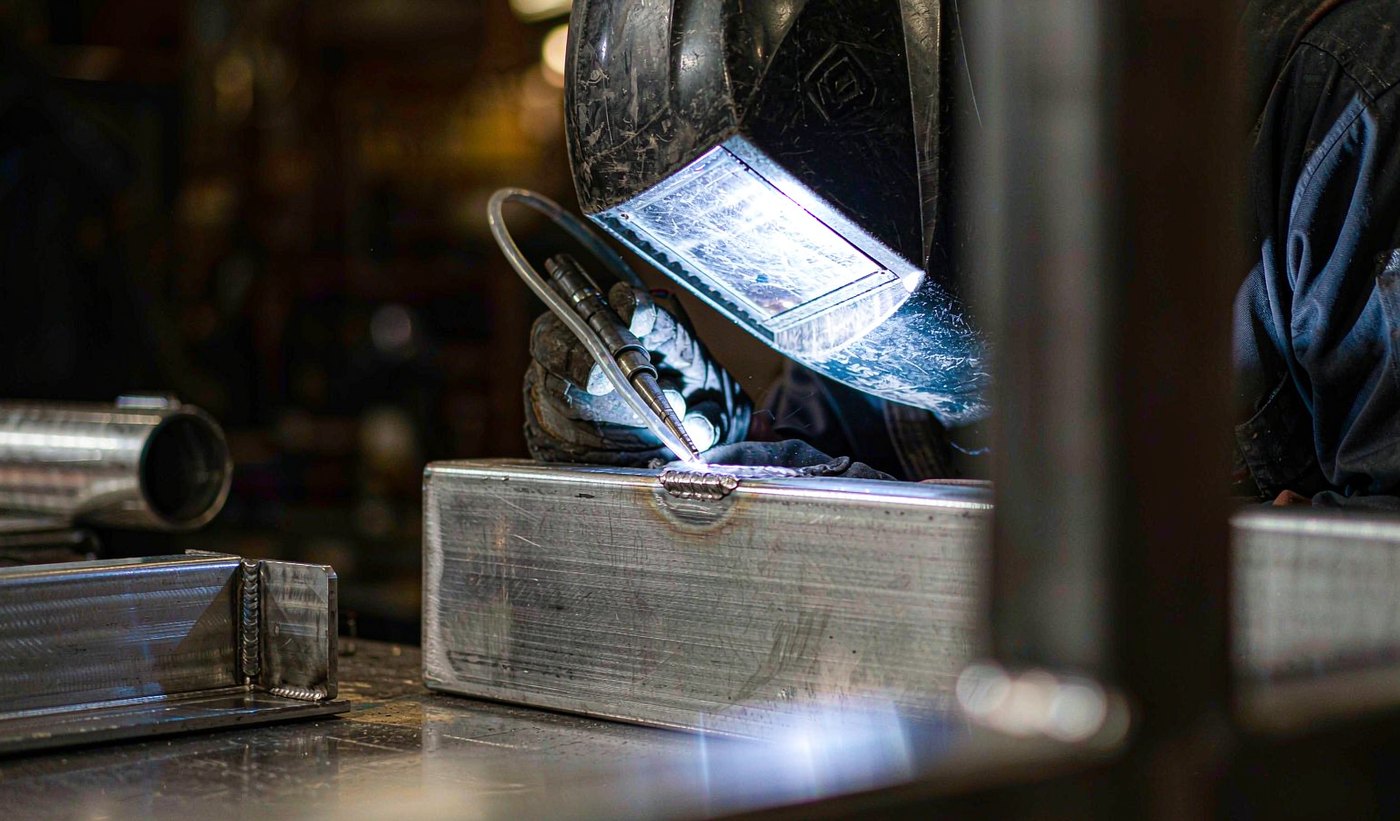
- Welding. Welds must be made with matching duplex filler (ER2209 is the standard choice) and a qualified WPS. Heat input and interpass temperature (typically capped around 150–200°C) must keep the weld and HAZ phase balance in range — too fast a cool-down produces excess ferrite and lost toughness, too slow or too hot promotes intermetallic phases. Autogenous welds without nitrogen addition to the shielding gas lose corrosion performance. Verification matters: a ferrite count on production welds and, for critical service, ASTM A923 testing to confirm no intermetallic phases. A shop that only welds 300-series will not get this right without procedure development.
- Forming. Expect noticeably more springback than 304 when press-braking frame profiles — overbend accordingly — and use bend radii of about 1.5–2× thickness rather than the tight radii 304 tolerates. Elongation of roughly 25% (versus 40% for 304) rules out deep-drawn sink bowls; drawn parts stay austenitic.
- Finishing. Brushed #4 and satin finishes are straightforward. Mirror polishing is difficult: the two-phase structure polishes unevenly and can show banding in reflective finishes. If a project demands 8K mirror aesthetic panels, 2205 is usually the wrong substrate.
- Post-weld restoration. Like all stainless, 2205 needs pickle-and-passivate treatment (ASTM A380 cleaning, ASTM A967 passivation) around welds. Grinding heat tint without chemical restoration leaves a corrosion-initiation site that no grade selection can rescue.
Where 2205 Is the Wrong Answer
An honest material guide also states the disqualifications, because 2205 specified outside its envelope fails in ways 304 would not:
- Continuous service above about 280°C. Long exposure above roughly 300°C promotes 475°C embrittlement and sigma phase in duplex structures. Ovens, sterilizers and exhaust-adjacent cladding should stay austenitic (310 or 316Ti territory).
- Cryogenic service below about −50°C. Duplex impact toughness falls off sharply at low temperature; 304L remains the standard for cryogenic equipment.
- Deep-drawn or complex stretched parts. Sinks, drawn basins and heavily formed trim pieces need 304's formability.
- Mirror architectural finishes. As above — the duplex microstructure fights reflective polishing.
- Swimming-pool atmospheres. Despite the high PREN, chloramine-containing indoor pool environments have attacked even 2205 structures in documented cases; pool halls need super-austenitic or super-duplex grades plus strict ventilation design.
- Dry inland interiors on a budget. Where 304 has decades of proven service, 2205 buys corrosion margin the project will never use. The correct grade is the cheapest one that survives the environment — 2205 included and 2205 excluded.
Specification Checklist for Buyers
- Call the exact standard. Specify UNS S32205 to ASTM A240 or 1.4462 to EN 10088-2 — not "duplex". S31803 is the legacy, lower-nitrogen composition; S32205 is the tighter modern version and the one to put on drawings.
- Ask for mill certificates with the corrosion-relevant elements. Chromium, molybdenum and nitrogen are what you are paying for; check them, not just mechanicals.
- Qualify the welding package. ER2209 filler, a WPS with heat input and interpass limits, ferrite verification on production welds, and ASTM A923 where service is critical.
- Require post-weld pickling and passivation to ASTM A380/A967, and inspect weld zones on delivery — heat tint is the most common shortcut on imported work.
- Optimize the gauge. Ask your fabricator to run the frame and door calculations on 2205's higher yield strength before defaulting to the 304 gauge schedule; this is where the cost premium is recovered.
- Match the finish to the grade. Brushed and satin finishes for 2205; if the design calls for mirror, raise the grade question with your supplier before committing.
Summary
Duplex 2205 occupies a specific, valuable slot between 316L and super-duplex: roughly double the yield strength of 300-series grades, a PREN around 35, far better crevice and stress-corrosion performance than 316L, and lower welding distortion on long frames. It earns its premium in coastal architecture, seafood and brine processing, chemical laboratories and water infrastructure — and it repays a fabricator who respects its welding, forming and finishing rules with assemblies that simply do not show the chloride failures that retire 304 and, eventually, 316L equipment. It is the wrong choice above 280°C, below −50°C, for deep-drawn parts, for mirror finishes and for dry interiors where 304 is already more than enough. The specification decisions that matter most: order S32205 by standard, verify the alloy content, insist on a duplex-qualified welding package, and let the strength advantage buy back part of the premium through gauge optimization.
📞 Contact FSGood Steel immediately to obtain a quote or technical consultation:
📧 Email – jason@fsgoodsteel.com
📱 Phone – +86 18370137709
💬 WhatsApp - +86 18007093101
🌐 Website – www.fsgoodsteel.com