
Stainless Steel Cabinets for Hospitals, Laboratories and Cleanrooms: A Specification Guide to Hygiene, GMP and Cleanability
Stainless Steel Cabinets for Hospitals, Laboratories and Cleanrooms: A Specification Guide to Hygiene, GMP and Cleanability
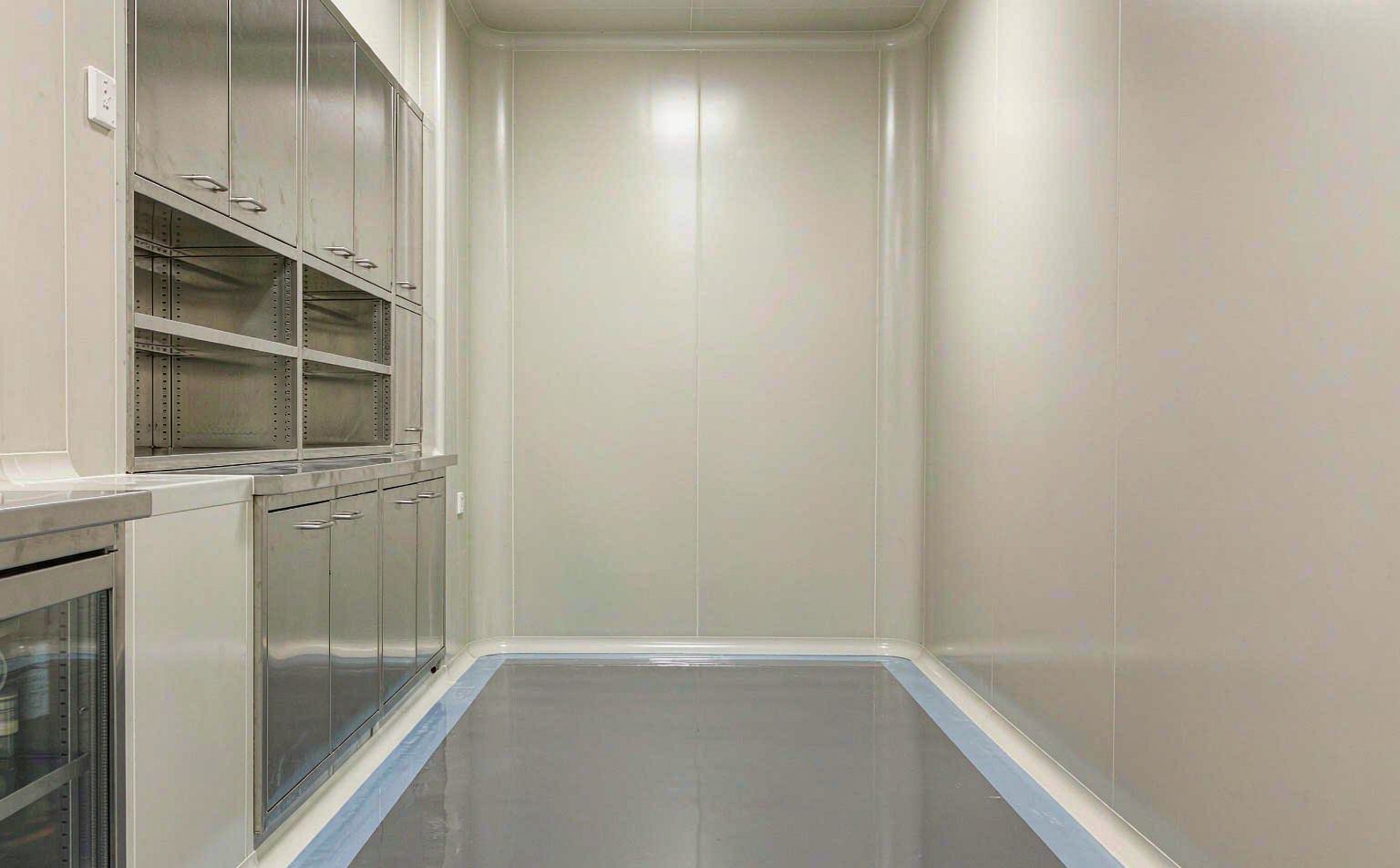
Stainless steel is the default material for hospital, laboratory and cleanroom cabinetry for good reasons: it does not support bacterial growth on a properly finished surface, it tolerates repeated disinfection, and it can be welded into a structure with no joints for soil to hide in. What it does not do is pass an audit by itself.
We see the same pattern across projects in the Gulf, Europe and Southeast Asia. A buyer specifies "304 stainless steel cabinet, No.4 finish" and receives something that meets that sentence exactly - and still fails a GMP inspection, an ISO 14644 classification check or an infection-control review. The grade was right. The geometry, the surface roughness, the weld treatment or the documentation was not.
This guide sets out what actually decides whether a stainless cabinet is acceptable in a clinical, laboratory or cleanroom environment, and how to write a specification that a fabricator can build to and an auditor can verify.
Grade is the easiest decision - and rarely the reason an audit fails
Almost every institutional cabinet project starts with a grade argument. In practice, most audit findings come from three other places: internal geometry that cannot be cleaned, weld zones left with heat tint, and a documentation pack that cannot prove what was supplied.
That is not an argument for ignoring grade. It is an argument for spending your specification effort in proportion to where the risk actually sits.
Three environments, three specifications
| Requirement | Hospital ward / treatment area | Laboratory | Cleanroom (ISO 14644) |
|---|---|---|---|
| Dominant risk | Cross-contamination, repeated disinfection, impact | Chemical attack, reagent spills, fume exposure | Particle shedding, cleanability of every exposed surface |
| Typical grade | 304 or 316L depending on disinfectant regime | 316L, 316Ti for aggressive chemistry | 304 or 316L, electropolished where specified |
| Surface | No.4 or 2B, Ra controlled on work surfaces | No.4 or 2B, Ra controlled, chemical resistance documented | BA or electropolished, low Ra, no directional scratch pattern |
| Internal geometry | Coved corners, sealed seams, no exposed fasteners | Coved corners, chemical-resistant gaskets, containment lips | Fully coved, minimal horizontal ledges, flush panels |
| Documentation | Mill certificate 3.1, cleaning validation support | Mill certificate 3.1, chemical compatibility statement, Ra report | Mill certificate 3.1, Ra report, weld and passivation records, particle-clean packing |
The same cabinet shape can serve all three environments, but not with the same detailed specification, and not at the same cost. Writing one specification for a hospital and a cleanroom usually produces either an over-specified hospital or an under-specified cleanroom.
Choosing the grade: 304, 316L and when the upgrade is mandatory
304 covers most general hospital casework and dry laboratory storage. It is the economical default and it is entirely adequate where the cleaning regime is neutral detergent and water, with occasional alcohol disinfectant.
316L becomes necessary when chlorides are part of normal operation - and in healthcare they usually are, in one of these forms:
- Hypochlorite-based disinfectants used routinely on surfaces
- Saline solutions and bodily fluids in clinical areas
- Chlorinated reagents, bleaches and acid spills in laboratories
- Coastal or high-humidity sites where the building itself is aggressive
Two practical points are worth stating plainly. First, no stainless grade is immune to concentrated hypochlorite left standing on a surface; the answer is a documented cleaning regime and immediate rinsing, not a more expensive alloy. Second, 304 is marginally magnetic after cold working and considerably more magnetic after deep drawing or forming - which matters to anyone specifying cabinetry for a magnetic resonance suite, where ferromagnetic components must be kept out of the field. If an MRI room is in scope, raise it at enquiry stage, because it changes fasteners, hinges and runners, not just the panel grade.
Surface finish and roughness: the number, not the name
"No.4 finish" describes an appearance, not a measurable surface. Auditors and cleaning-validation protocols work with roughness, usually expressed as Ra in micrometres. The names and the numbers correlate, but not tightly enough to rely on the name alone.
| Finish | Typical Ra | Character | Where it fits |
|---|---|---|---|
| 2B | Approximately 0.3-0.5 um | Smooth, low reflectivity, non-directional | General casework, internal faces, hospital storage |
| BA (bright annealed) | Approximately 0.1 um or better | Bright, very smooth, non-directional | Cleanroom panels, visible surfaces in controlled areas |
| No.4 | Approximately 0.8-1.2 um | Directional brushed grain | Work surfaces, equipment fronts, general healthcare use |
| Electropolished | Typically below 0.2 um, with a chromium-enriched surface | Mirror-like, chemically smoothed, least particle-retentive | Cleanroom interiors, pharmaceutical and biological applications |
Values are indicative and depend on mill, processing and measurement method - specify the measurement method and the acceptance value, not only the finish name. On a directional grain, orientation matters as well: brushes and wipes travel across the grain, not along it, and a cabinet detailed with vertical grain on a horizontal ledge is harder to clean than the roughness number suggests.
Design for cleanability: where cabinets actually fail
Cleanability is a geometry problem before it is a material problem. These are the details that separate institutional-grade cabinetry from domestic-grade cabinetry in the same alloy.
- Coved internal corners. Internal corners radiused rather than square, typically 6 mm or more, so a cloth reaches the corner. Square corners harbour residue regardless of finish.
- No exposed fasteners on internal or upward-facing surfaces. Screw heads and rivets are particle traps and corrosion initiation sites. Fix from concealed faces or use welded or bonded construction.
- Sealed or welded seams, not silicone as a structural solution. Silicone is a service item and a mould reservoir. Where it is unavoidable, specify a sanitary grade and a replacement interval.
- Radiused and closed door edges. Folded edges that trap water are a common finding on budget cabinetry; a closed hem or a welded and ground edge is not.
- Sloped or radiused tops. Horizontal surfaces collect dust in a cleanroom and supplies in a ward. Where a top is unavoidable, slope it or keep it clear by design.
- Plinth or toe kick with a sealed floor junction. Either a removable plinth for cleaning underneath or a fully sealed base - never an open gap that a mop cannot reach.
- Removable shelves and smooth runners. Shelves should lift out for cleaning; runners should be covered or captured so debris cannot enter the track.
- Drainage and containment where liquids are handled. Sinks and wet areas need a fall, a drain and a raised lip, with the cabinet structure protected from overflow.
Where the project is audited against a sanitary standard, reference it explicitly in the specification - NSF/ANSI 2 for food equipment construction, the 3-A sanitary standards where dairy or pharmaceutical processing is involved, and EU GMP Annex 1 for Grade A and B cleanroom zones. Each standard constrains geometry in specific ways, and fabricators who do not build to them routinely will miss details that are obvious to an inspector.
Components that fail first in service
Panels rarely fail. Fittings do. Specifying these deliberately is cheaper than replacing them in an operating hospital.
| Component | Typical failure | Specification fix |
|---|---|---|
| Hinges | Corrosion at the pin, sagging door, crevice at the mounting plate | 304 or 316 hinge with concealed fixing, defined cycle rating, no exposed adjustment slots on the clean side |
| Drawer runners | Debris in the track, roller failure under repeated disinfection | Captured or covered runner, stainless or polymer rollers, load rating matched to actual drawer use |
| Weld zones | Heat tint, chromium depletion, rust bloom within months | Pickling and passivation after welding, documented, with the heat-affected zone treated - not wire-brushed only |
| Gaskets and seals | Mould growth, hardening, loss of seal | Specify the elastomer, the temperature and chemical exposure it must survive, and its replacement interval |
| Castors and levelling feet | Corrosion, floor marking, failure at the stem | Stainless housings, non-marking wheels, load rating per position rather than per cabinet |
| Shelving | Deflection under load, permanent set | Specify load per shelf and the deflection limit, not just the material thickness |
The documentation pack auditors ask for
In institutional projects the paperwork is part of the product. A cabinet without traceable documentation is a cabinet that cannot be accepted, however well it is made.
- Mill certificates to EN 10204 3.1 for the coil or sheet used, with heat numbers traceable to the delivered cabinet - not a generic certificate for "304".
- Surface roughness report with the measurement method, instrument and sample locations.
- Weld and passivation records, including welder qualification where the standard requires it, and the pickling or citric passivation method used.
- Chemical compatibility statement listing the disinfectants and reagents the finish is expected to withstand, and any exclusions.
- Food-contact or material compliance declarations where relevant - EU 1935/2004, FDA-compliant materials, RoHS and REACH statements.
- Cleaning and maintenance instructions with the disinfectant chemistry the surface was designed for. Auditors ask for this more often than suppliers expect.
Fabrication tolerances, shipping and installation
Three practical constraints decide whether a good cabinet arrives as a good installation.
- Module sizing against building access. A welded cabinet that cannot pass a lift door or a corridor corner becomes a site modification. Confirm the largest transportable module before drawings are released, and design for knockdown construction where access is restricted.
- Site welding contamination. Any welding done on site requires the same post-weld treatment as factory welding. If site welding is likely, specify who performs the passivation and how it is recorded.
- Floor and wall conditions. Level tolerance, wall squareness and the method of fixing to the structure should be agreed before fabrication, because coved junctions at skirting level depend on them.
For export projects, add two lines to the specification that are easy to forget: edge and corner protection that survives ocean freight, and a packing method that keeps the surface-critical faces out of contact with strapping and timber. A cabinet that arrives with transit marks on the clean side is a rework item in a building that is already in commissioning.
Specification checklist
- Grade by area: 304, 316L or 316Ti, with the chloride exposure that justified the choice
- Surface finish by surface: name, Ra value, measurement method, grain orientation
- Internal geometry: corner radius, seam treatment, fastener policy, ledge policy
- Door and drawer hardware: grade, cycle rating, concealed fixing, load rating
- Weld treatment: method, standard, documentation
- Gaskets and seals: elastomer, temperature and chemical exposure, replacement interval
- Base detail: plinth or sealed base, floor junction method
- Documentation: certificate grade, Ra report, passivation records, compliance declarations
- Module sizes against site access, and who treats site welds
- Packing: surface protection, edge protection, moisture control
Frequently asked questions
Is 304 acceptable for a hospital, or must it be 316L?
304 is widely acceptable for general ward and storage casework. 316L becomes the practical requirement where chlorinated disinfectants, saline or chloride-bearing reagents are routine. The deciding document is your cleaning and disinfection protocol, not the building type.
What corner radius should we specify?
A radius of 6 mm or more on internal corners is a common institutional baseline, and sanitary standards may require more in specific applications. What matters is that the radius is stated, drawn and inspectable - "coved corners" alone is not a specification.
Does a brushed No.4 finish pass a cleanroom requirement?
Usually not for critical surfaces. No.4 carries a directional grain in the region of 0.8-1.2 um Ra, which retains particles and residue more than BA or electropolished surfaces. For ISO-classified zones, specify BA or electropolished with a stated Ra limit.
Can you supply cabinets for a magnetic resonance area?
It requires a specific build: non-ferromagnetic hinges, runners and fasteners, and confirmation of the magnetic response of the panels used. This must be raised at enquiry, because it changes the bill of materials rather than only the finish.
What documents should arrive with the cabinets?
At minimum EN 10204 3.1 mill certificates with heat-number traceability, a surface roughness report, weld and passivation records, relevant compliance declarations and cleaning instructions. On audited projects, ask for the document list at quotation stage so it is priced in.
Send us the room schedule, the cleaning and disinfection protocol, the standard you will be audited against and your access constraints. We will return a fabrication specification that matches those documents clause by clause - grade by area, Ra by surface, corner radii, hardware and the documentation pack - and we will tell you where a cheaper detail would pass and where it would not.
📞 Contact FSGood Steel immediately to obtain a quote or technical consultation:
📧 Email – jason@fsgoodsteel.com
📱 Phone – +86 18370137709
💬 WhatsApp - +86 18007093101
🌐 Website – www.fsgoodsteel.com