
Stainless Steel Cabinets and Doors: Why the Weld Zone, Not the Grade, Decides Service Life
Jason | Goodsteel Technical Analysis Department
Two stainless steel cabinets leave two factories on the same day. Both are 304, both are 1.0 mm, both look identical under showroom lighting. Three years later one is still flat, clean and square; the other has rust blooming along its internal corners, a door leaf that no longer closes evenly, and a hygiene finding on its first third-party audit. The difference is almost never the grade printed on the mill certificate. It is what happened to the steel in the 20 mm around each weld — and what the factory did, or did not do, after the torch was switched off.
This note is written for buyers, project engineers and fabricators specifying stainless steel kitchen cabinets and stainless steel doors in 2026. It covers the metallurgy that decides corrosion performance, the finishing steps that restore it, the geometry that decides whether a cabinet passes an audit, and the checks that separate a genuine fabricator from an assembler.
1. What Welding Actually Does to 304
Stainless steel protects itself with a chromium-oxide passive film that reforms instantly in air — provided there is enough chromium at the surface to form it. Welding interrupts that. In the heat-affected zone, the metal passes through roughly 425–870 °C, and in that window carbon migrates to the grain boundaries and combines with chromium to form chromium carbide (Cr₂₃C₆). The boundaries are left chromium-depleted, sometimes below the ~12% needed to sustain the passive film. The result is intergranular corrosion, known in the trade as weld decay.
The controlling variable is carbon, not nickel or chromium. A typical TIG weld on 3 mm sheet holds the heat-affected zone in the sensitisation range for 30–60 seconds — long enough for carbides to begin forming in standard 304, not long enough to matter in the low-carbon grades. On thicker sections or multi-pass seams the dwell time stretches to minutes, and the argument becomes decisive.
| Grade | Carbon (max) | Weld-zone behaviour | Specify when |
|---|---|---|---|
| 304 | 0.08% | Sensitisation possible in heavy, multi-pass or slowly cooled welds | Light-gauge panels, dry indoor service, low chloride |
| 304L | 0.030% | Effectively immune to sensitisation in thin sheet | Welded carcasses, door frames, continuous seams |
| 316L | 0.030% + 2–3% Mo | Low carbon plus molybdenum for chloride resistance | Coastal sites, brine, bleach disinfection, dairy and pharma |
A practical note for procurement: most flat-rolled 304 produced today is dual-certified 304/304L, because AOD refining naturally lands below 0.03% carbon. Ask for dual certification in writing. It costs nothing and removes the entire argument from the drawing stage.
2. Heat Tint Is a Corrosion Map
The straw, gold, blue and dark grey discoloration along a weld is an oxide layer, and its colour is a thickness gauge. Darker tint means a thicker oxide and a deeper chromium-depleted zone beneath it. That zone is also microscopically rough, so it traps polishing residue, cleaning chemistry and organic soil — which is precisely the combination that starts crevice corrosion. In a chloride-bearing environment, tint left inside a cabinet corner or under a door frame can initiate attack within the first service cycle, on 304 or 316 alike.
Two consequences follow. First, tint is not cosmetic and cannot be accepted on a "looks fine at arm's length" basis. Second, the presence of tint tells you something about the rest of the process: a factory that leaves it on visible seams has almost certainly left it inside the carcass too, where nobody will look until the cabinet is installed.
3. Pickling, Passivation and the Grinding Trap
These two treatments are routinely confused in quotations, and the confusion costs buyers real money.
- Pickling (referenced to ASTM A380 for cleaning and descaling) is an aggressive acid treatment that removes the oxide, the heat tint and the chromium-depleted layer. It intentionally removes a thin layer of base metal.
- Passivation (ASTM A967) is a milder treatment that removes free iron and surface contamination so the passive film can rebuild. It does not remove heat tint, and it does not restore a depleted zone.
If a weld shows tint, passivation alone will not fix it. The correct sequence is degrease, pickle, rinse thoroughly, passivate, rinse with low-chloride water, dry. Rinsing deserves its own line in the specification: acid residues trapped at weld toes, in crevices and inside folded edges cause staining and localised attack that looks exactly like a material defect.
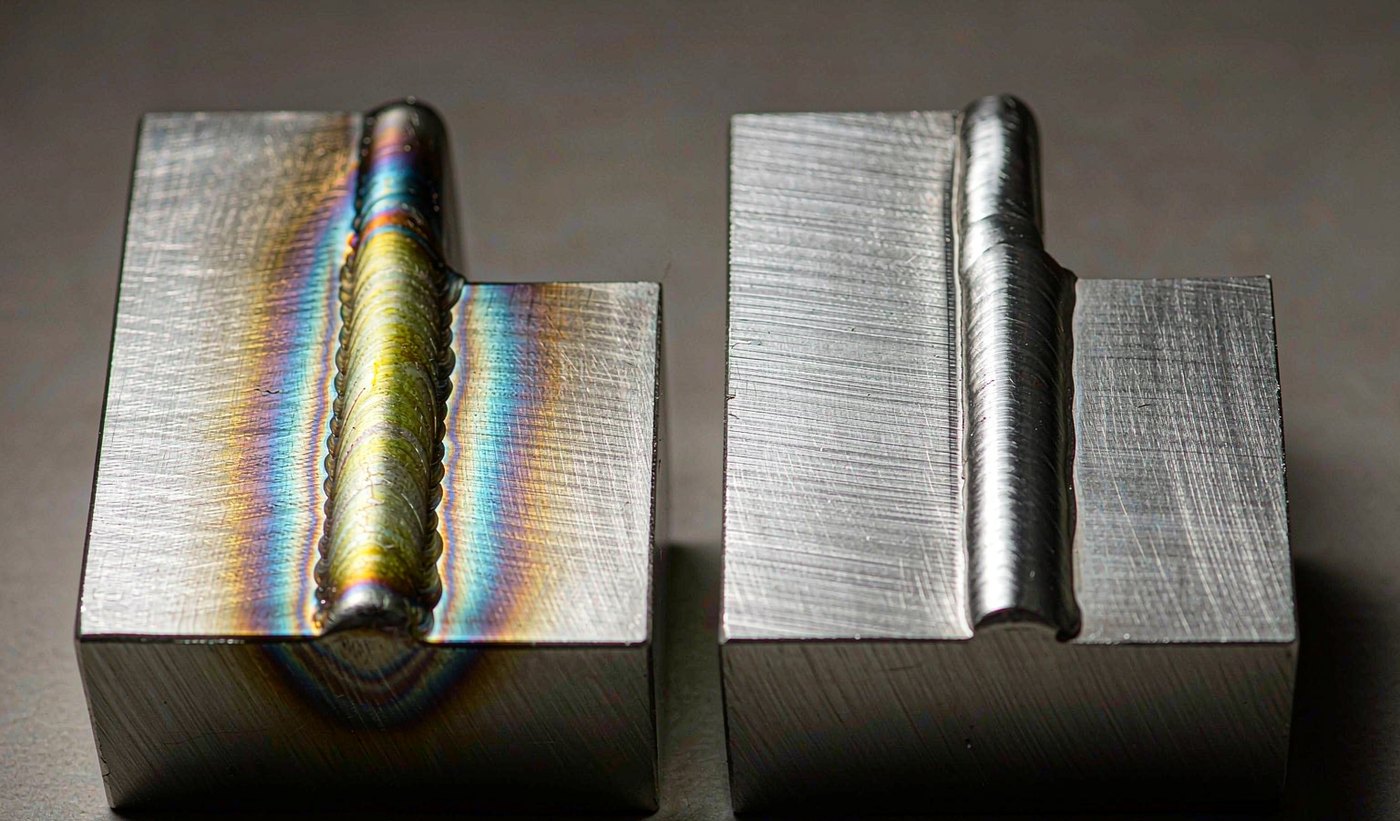
The grinding trap. Grinding and wire-brushing remove the colour, not the chemistry. The depleted layer survives, and worse, discs and brushes that have touched carbon steel embed free iron into the stainless surface, which then rusts and defeats the whole exercise. If mechanical finishing is used, specify stainless-dedicated consumables, follow with passivation, and verify with a free-iron test rather than a visual check.
4. Geometry: The Details an Auditor Measures
Corrosion resistance is half the specification. The other half is cleanability, and it is dimensional. Under the hygienic design logic of NSF/ANSI 2-2022, food zones and splash zones are treated separately, and the requirements that most often fail imported cabinets are geometric:
| Detail | What a competent specification asks for |
|---|---|
| Internal corner radius | Not less than 1/8 in (3.2 mm) at plane junctions; where three planes meet, the third corner not less than 1/4 in (6.4 mm) |
| How the radius is made | Formed in the parent metal — not built up with weld filler, and never with a silicone bead |
| Welds in food and splash zones | Continuous, full penetration, ground flush and polished to match the surrounding finish |
| Stitch welds | Acceptable on hidden frame members only; every gap between stitches is a capillary that fills and never dries |
| Upstand and splashback | Coved return formed from the same sheet, in preference to a silicone joint |
| Hollow sections and legs | Sealed at both ends, so a leg standing in wash water cannot wick moisture upward |
| Drainage | Falls to a drain point or a raised edge that contains spillage; no flat areas where water stands |
Surface finish belongs in the same table, because Ra — not gloss — is what determines cleanability. A 2B mill finish typically measures Ra 0.3–1.0 µm, a #4 brushed finish 0.6–0.9 µm, and electropolishing goes lower still. Food-contact surfaces are commonly specified at Ra ≤ 0.8 µm, and dairy, brewing and pharmaceutical work often at ≤ 0.5 µm. The question to put to a supplier is not what the sheet arrived at, but what Ra the finished weld achieves after grinding and passivation.
5. Doors: Distortion Is a Welding Problem, Not a Polishing Problem
Stainless door leaves fail visually far more often than they fail structurally. A welded frame pulls as it cools, the skin oils-cans, the leaf warps, and the hinge binds two millimetres out of position. Polishing cannot correct any of it. What corrects it is process discipline: controlled heat input, a balanced tacking sequence that works from the centre outward, back purging on TIG to protect the root, chill bars or copper backing on thin decorative faces, and enough restraint not to over-weld a visible surface.
For doors, four tolerances are worth writing into the PO rather than assuming: flatness of the leaf measured after finishing rather than before (for example ≤ 1.5 mm per metre), squareness of the leaf diagonals (for example ± 1 mm on a 700 mm leaf), uniform reveal gaps around the leaf (typically 1.5–2 mm), and reinforcement plates welded at hinge positions so the fixings load plate rather than skin. On very large leaves, a folded or hemmed edge with concealed frame welds usually delivers a flatter door than an exposed mitre weld — and it removes a food trap at the same time.
6. Eight Lines to Put in the Purchase Order
- Grade and carbon content, with EN 10204 3.1 mill certificates and heat numbers traceable to the delivered sheets.
- Actual sheet thickness and the locations where reinforcement is required — base, shelf span, hinge line.
- Weld schedule: continuous full penetration on all food and splash surfaces; stitch welding confined to hidden structure.
- Post-weld treatment: pickle and passivate to ASTM A380/A967, inside and outside, documented, with rinse-water quality stated.
- Hygienic geometry: internal radii, coved returns, sealed hollow sections, drainage fall.
- Finish and Ra: finish type, grain direction, and the Ra target measured on the finished weld.
- Flatness and fit tolerances for door leaves and carcass, measured after finishing.
- Inspection package: first-article report, weld cross-section on request, free-iron test result, packing method for transit.
7. Verifying It in Half an Hour
None of this requires a laboratory. A buyer can sanity-check a sample cabinet in one visit: inspect welds under raking light rather than straight on; run a water-break test, where a continuous water film that holds for 30 seconds indicates a clean surface and a film that breaks immediately indicates organic contamination; ask for a ferroxyl or copper-sulfate free-iron test on a weld and a formed corner; measure Ra on the weld and on the parent sheet with a handheld gauge; and request a macro-etched cross-section from the first-off sample to see penetration, undercut and porosity.
Salt spray testing to ASTM B117 is useful as a comparative reference but a poor predictor on its own — hours in a chamber do not reproduce a decade of grease, chloride and daily washing. The specimen that survives is the one that was pickled, passivated, and geometrically clean, not the one with the longest claimed hour count.
8. The Cost Argument
Pickling and passivation add visible cost: a chemical line, effluent treatment, handling, and labour per square metre. That is exactly why it is the first step cut by factories competing on unit price, and why the saving is invisible until it is not. The cost of skipping it surfaces later as a rust complaint, a replaced cabinet run, or an audit finding that stops a kitchen from opening. On a project basis, the finishing step is a line item; the failure is a programme risk.
9. What Goodsteel Delivers
Goodsteel fabricates stainless steel kitchen cabinets and door systems in Foshan, from 304, 304L, 316L and 430 sheet, with the process steps described above kept in-house rather than outsourced:
- Laser cutting, CNC bending, TIG welding and weld cleaning under one roof
- Pickling and passivation of welded assemblies, with Ra verification on request
- Brushed, mirror, matte and anti-fingerprint finishing, with grain direction matched across panels
- Cabinet carcasses, door leaves, frames and custom enclosures built to your drawings and tolerances
- Mill certificates and heat-number traceability on every stainless component
- Factory-direct pricing with FOB Foshan, and production support from single project sets to framework supply
If your project is audited against NSF/ANSI 2 or a 3-A sanitary standard, send us the clause list with the drawings. We will fabricate to the geometry and finish those clauses call for, and supply the documentation your inspector asks for. And if a different grade, a foam core or a heavier gauge is genuinely the better answer for your application, we will tell you so before you place the order.
Send a drawing, the cleaning regime the cabinet will live under, and the tolerances that matter to your installer. That is enough for us to quote a specification rather than a price.
📞 Contact FSGood Steel immediately to obtain a quote or technical consultation:
📧 Email – jason@fsgoodsteel.com
📱 Phone – +86 18370137709
💬 WhatsApp - +86 18007093101
🌐 Website – www.fsgoodsteel.com