
Stainless Steel Coil Slitting: A Buyer’s Guide to Custom Widths and Tolerances
Stainless Steel Coil Slitting: A Buyer’s Guide to Custom Widths and Tolerances
Many stainless steel buyers do not need a full-width master coil. Their production lines may require narrow strips for stamping, fabrication, automotive components, kitchen equipment, architectural products, or other downstream applications.
In these situations, stainless steel coil slitting can be an efficient solution.
Slitting allows a wider stainless steel coil to be processed into narrower coils according to the buyer's required width. However, width alone is not enough when placing a slitting order.
Buyers should also consider width tolerance, edge condition, burrs, coil weight, winding quality, packaging, and the intended downstream process.
This guide explains the key factors international buyers should understand before ordering slit stainless steel coils.
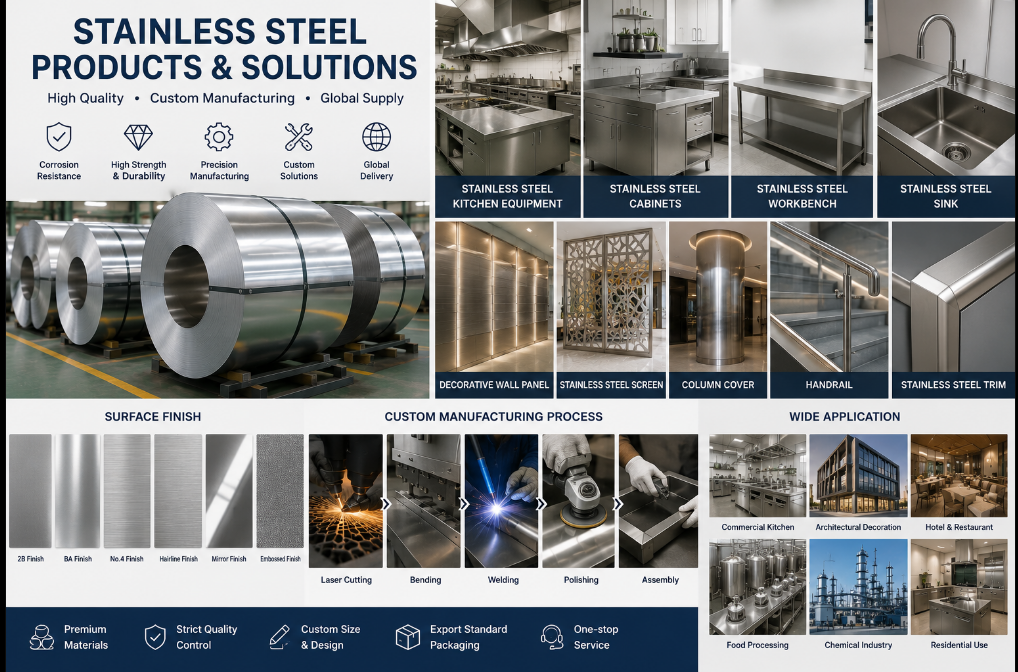
What Is Stainless Steel Coil Slitting?
Stainless steel coil slitting is a process in which a wide master coil is divided longitudinally into narrower strips.
The process generally uses circular knives or slitting tooling to cut the material along the coil's length.
For example, a master coil with a width of 1219 mm may be processed into several narrower strips according to the required dimensions and production plan.
The exact slit-width combination depends on the original coil width, required finished widths, trimming requirements, and the supplier's slitting equipment.
Why Do Buyers Need Slit Stainless Steel Coil?
Custom-width coils can provide several practical benefits.
Reduced Downstream Processing
If the buyer's production line requires 100 mm-wide stainless steel strips, receiving a suitable slit width can reduce the need for cutting at the buyer's facility.
Improved Material Utilization
Correctly planned slit widths can help reduce unnecessary trimming and material waste.
Easier Production
Slit coils can be directly supplied to certain stamping, forming, fabrication, and automated production processes.
Better Inventory Management
Buyers can order the dimensions actually required by production instead of storing large quantities of master coils.
What Specifications Should Be Confirmed?
A stainless steel slitting order should normally include more information than simply:
304 stainless steel slit coil, 100 mm.
A professional specification should include:
Stainless steel grade
Thickness
Master coil width
Finished slit width
Width tolerance
Surface finish
Edge condition
Inner diameter
Outer diameter or maximum coil diameter
Coil weight
Slit quantity
Applicable standard
Packaging requirements
These details help the supplier understand the actual production requirement.
Slit Width Tolerance
Width tolerance is one of the most important technical requirements.
For example, a buyer may require:
100 mm width ± 0.10 mm
The supplier needs to confirm whether this tolerance can be achieved consistently with the selected material thickness, slitting equipment, and production conditions.
The required tolerance should therefore be specified before production.
Buyers should avoid requesting an extremely tight tolerance without confirming whether it is necessary for the final application.
A tighter tolerance may require additional production control and inspection.
Edge Quality After Slitting
Slitting changes the original coil edge.
Depending on the equipment, material thickness, tooling condition, and process parameters, the slit edge may have different characteristics.
Important factors can include:
Burr height
Edge straightness
Edge cracking
Edge deformation
Surface damage near the slit edge
For applications involving precision forming or automated feeding, edge quality can be particularly important.
Buyers should communicate the downstream process so the supplier can understand the required edge condition.
Burr Control
Burr is a small raised edge that can occur during the cutting process.
The acceptable burr level depends on the application.
For general fabrication, a small amount of burr may be acceptable.
For precision applications, however, excessive burr can interfere with:
Automatic feeding
Stamping
Bending
Welding
Assembly
Worker handling
If burr height is critical, the buyer should include a specific requirement in the technical specification.
Surface Finish Must Be Protected
Stainless steel with decorative surfaces such as No.4, Hairline, or Mirror requires careful handling during slitting.
Potential risks include:
Scratches
Pressure marks
Contamination
Edge damage
Film damage
Protective film and appropriate packaging may therefore be necessary depending on the application.
For visible architectural products, buyers should communicate surface protection requirements before production.
Slit Coil Inner Diameter
The inner diameter of a slit coil can affect compatibility with the buyer's equipment.
For example, automated processing equipment may require a specific coil ID for mounting on a decoiler or expansion mandrel.
Common requirements may include a specified inner diameter such as:
300 mm
400 mm
508 mm
Other customized dimensions
The correct requirement depends on the buyer's processing equipment.
If the coil will be loaded directly onto a production line, the buyer should confirm the required ID before ordering.
Coil Weight and Outer Diameter
The buyer may also need to specify maximum coil weight or maximum outer diameter.
This can be important when:
Using automatic decoilers
Handling coils with cranes
Loading production equipment
Transporting multiple coils
Optimizing warehouse storage
A supplier may be able to produce a required slit width but still need to adjust the coil weight or winding configuration to match the buyer's equipment.
How Slitting Affects Material Yield
Slitting can improve material utilization, but the result depends on how the master coil width is divided.
For example, if the master coil width is not a perfect combination of the required slit widths, some trimming or leftover material may be generated.
Therefore, buyers should discuss the slit-width arrangement with the supplier before production.
A professional supplier can review the master coil width and determine an efficient slitting pattern.
Example of a Slitting Requirement
A typical RFQ might specify:
Material: 304 stainless steel
Thickness: 1.0 mm
Master width: 1219 mm
Slit width: 100 mm
Width tolerance: ±0.10 mm
Surface: 2B
Inner diameter: 508 mm
Edge: Slit edge, controlled burr
Quantity: 10 MT
Application: Metal fabrication
Destination: [Port / Country]
The supplier can then confirm whether the requested dimensions and tolerances are suitable for production.
Stainless Steel Slitting for Different Applications
Different industries may have different requirements.
Automotive Components
Precision width, edge condition, and consistent material properties can be important for automated production.
Kitchen and Appliance Manufacturing
Consistent width and surface quality can help downstream forming and fabrication.
Architectural Metalwork
Surface appearance and scratch protection may become more important than extremely tight dimensional tolerances.
Metal Fabrication
Standard slit widths may provide a practical balance between processing efficiency and material cost.
Stamping and Forming
Coil dimensions, edge quality, thickness, and mechanical properties can all influence production performance.
The supplier should understand the final application before recommending a slitting specification.
How to Choose a Stainless Steel Coil Slitting Supplier
When evaluating suppliers, buyers should look beyond the quoted price.
Important questions include:
What stainless steel grades can the supplier slit?
What thickness range can the slitting line process?
What finished widths are available?
What width tolerances can be maintained?
What edge conditions can be provided?
What coil IDs are available?
What is the maximum coil weight?
How is the slit coil inspected?
How is the material packaged for export?
Can the supplier provide samples before mass production?
These questions help determine whether the supplier's processing capability matches the buyer's requirements.
Slit Coil Inspection
Before shipment, buyers may want to verify:
Material grade
Thickness
Width
Width tolerance
Surface condition
Edge condition
Coil weight
Coil ID
Packaging
Quantity
For repeat orders, maintaining the same specification and inspection procedure can help improve consistency between batches.
How FSGOOD STEEL Supports Custom Stainless Steel Coil Requirements
For buyers who require specific widths, the most efficient approach is to provide the complete technical requirement at the quotation stage.
The supplier can then evaluate the required grade, thickness, master width, finished slit width, tolerance, coil dimensions, packaging, and quantity together.
This reduces unnecessary adjustments after the order has entered production.
Frequently Asked Questions
What is stainless steel coil slitting?
Stainless steel coil slitting is the process of cutting a wide stainless steel master coil into narrower strips along its length.
Can 304 stainless steel coil be slit to custom widths?
Yes, 304 stainless steel coil can commonly be processed into narrower slit coils, subject to the supplier's equipment, material thickness, required width, and tolerance.
What information do I need to order slit coil?
At minimum, buyers should provide grade, thickness, finished width, width tolerance, surface finish, quantity, and applicable standard. Coil ID, weight, edge condition, and packaging should also be confirmed when relevant.
Does slitting increase the stainless steel coil price?
Slitting is an additional processing operation, so it can affect the final price. The impact depends on quantity, dimensions, tooling, tolerances, packaging, and other production requirements.
Why is width tolerance important?
Width tolerance determines how closely the finished slit coil matches the requested dimension. It can be particularly important for automated production, stamping, forming, and precision fabrication.
Final Thoughts
Stainless steel coil slitting can help international buyers obtain material that is closer to their actual production requirements.
However, successful slitting procurement requires more than specifying a finished width.
Buyers should consider grade, thickness, width tolerance, edge quality, burr control, coil ID, coil weight, surface protection, and packaging before confirming an order.
A well-defined slitting specification can reduce downstream processing, improve material utilization, and make production planning more predictable.
For buyers sourcing stainless steel slit coils internationally, the goal should be to establish a specification that balances dimensional accuracy, production efficiency, material yield, and total purchasing cost.
📞 Contact FSGood Steel immediately to obtain a quote or technical consultation:
📧 Email – [sales@fsgoodsteel.com]
📱 Phone – [+86 18370137709]
💬 WhatsApp - [+86 18007093101]
🌐Website – www.fsgoodsteel.com