
Commercial and Outdoor Stainless Steel Cabinets: Design, Materials and Bulk Sourcing
Introduction
Commercial kitchens, hospitality facilities and outdoor cooking areas need cabinetry that fits the environment, workflow and maintenance routine. Stainless steel is often considered because of its clean appearance, durability and practical maintenance characteristics.
However, not every stainless steel cabinet is suitable for every application. Commercial kitchens may involve frequent cleaning, grease, moisture and heavy daily use, while outdoor installations may face rain, humidity, temperature changes and coastal exposure.
For kitchen equipment distributors, hospitality contractors, outdoor kitchen brands and project buyers, choosing the right cabinet begins with understanding how it will be used.
1. Commercial and Outdoor Cabinets Have Different Requirements
Commercial kitchens often prioritize workflow, storage capacity, cleanability and repeated daily operation. Cabinet layouts may need to accommodate utensils, cleaning supplies, equipment, ingredients or service components.
Outdoor kitchens introduce additional environmental factors. Cabinets may be exposed to rain, humidity, airborne contaminants and, in coastal locations, salt. These conditions can affect the required material grade, hardware, fasteners and installation details.
Before requesting a quotation, tell the supplier whether the cabinets will be installed indoors, in a covered outdoor area or in a fully exposed location.
A cabinet designed for indoor use should not automatically be assumed suitable for permanent outdoor exposure.
2. Choose the Stainless Steel Grade for the Environment
Grade 304 stainless steel is commonly used for many indoor kitchen and general food-service applications. Grade 316 may be considered for more aggressive environments, including some coastal or chloride-exposed locations.
The right grade depends on actual exposure, cleaning chemicals, maintenance and project requirements. It is also important to review the complete assembly rather than only the visible panels.
Hinges, fasteners, drawer slides, brackets and other components can have different material specifications and corrosion behavior. Ask the supplier to identify the materials used in critical components and confirm any limits on outdoor applications.
3. Design Cabinets Around Cleaning and Workflow
Good cabinet design can make everyday work easier.
For commercial applications, consider smooth surfaces, accessible corners, appropriate clearances and joints that are practical to clean. Cabinet dimensions should be coordinated with the equipment layout and the kitchen workflow.
Useful configuration options may include:
Adjustable shelves
Drawers and lockable compartments
Integrated handles
Backsplashes and side panels
Appliance and plumbing cut-outs
Casters or adjustable feet
Custom worktop and cabinet dimensions
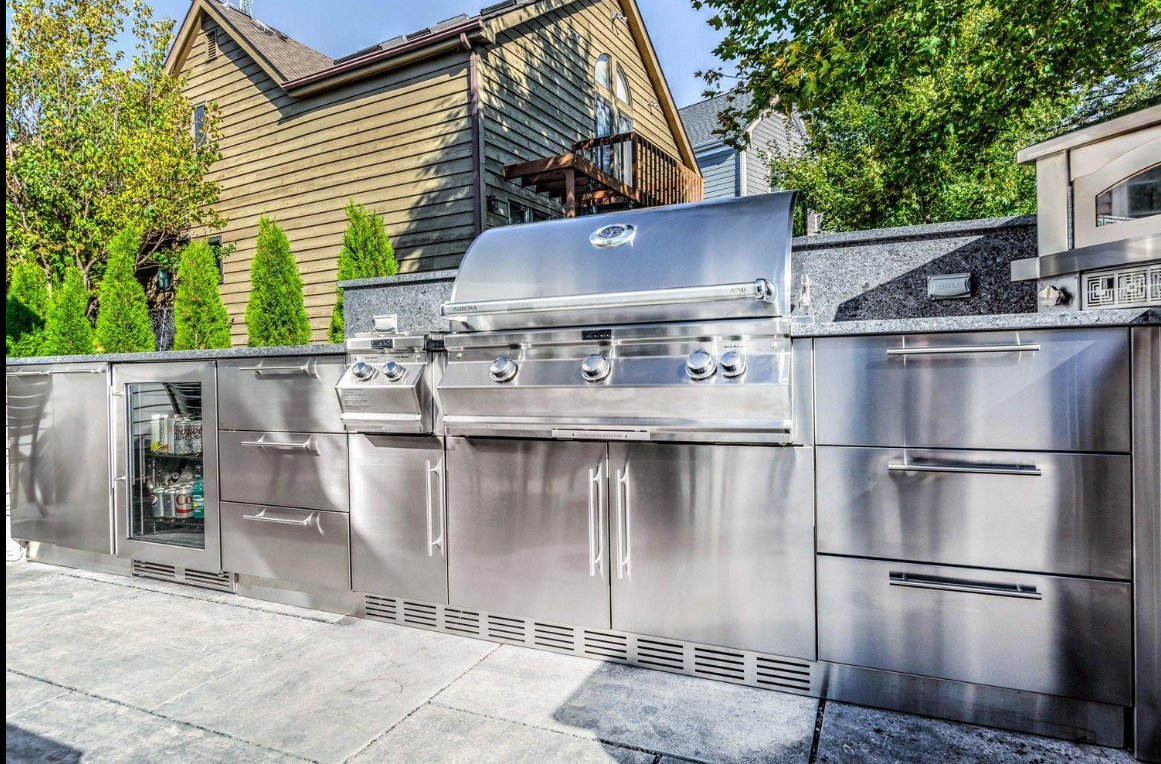
For outdoor kitchens, coordinate cabinets with grills, sinks, refrigeration equipment, countertops and service connections. Confirm clearances and access requirements before production.
4. Construction and Hardware Matter
A cabinet’s durability depends on its complete construction. Sheet thickness is only one factor; folded edges, reinforcements, frame design, shelf spans, hinges and mounting points also influence strength.
If cabinets will support heavy equipment or experience frequent use, describe the expected load and operating conditions. Ask the supplier to specify the proposed structure and hardware.
For outdoor installations, review the cabinet base, legs, leveling feet and mounting details. Discuss drainage and ventilation where water could accumulate, and ensure the installation design is appropriate for the location.
5. Select a Finish That Matches the Project
Brushed stainless steel is often selected for professional kitchens and modern outdoor designs. Polished and decorative finishes may be suitable for other concepts, but appearance, scratch visibility and maintenance requirements can vary.
Request representative samples or photographs and confirm that the finish will be consistent across doors, drawers, side panels and trim.
For a project with many cabinets, a written finish schedule helps reduce variation between units and makes future replenishment easier.
6. Bulk Sourcing and OEM Manufacturing
For distributors and contractors, consistency across the order is essential. Prepare a bill of quantities, drawings, model list, delivery schedule and packaging requirements.
If cabinets will be sold under your own brand, discuss labeling, carton design, manuals, spare hardware and prototype approval. Confirm which dimensions are standard and which are project-specific.
For multi-location projects, approving a sample unit before mass production can help establish the expected finish, construction and hardware configuration.
7. Quality Inspection Before Dispatch
A practical inspection checklist may include:
Overall dimensions and squareness
Door and drawer alignment
Hinge and slide operation
Weld appearance and edge smoothness
Shelf supports and reinforcement
Hardware and accessory count
Finish consistency between units
Packing protection and labeling
Inspection requirements should be agreed before manufacturing. If third-party inspection or load testing is required, define the scope and acceptance criteria in advance.
8. Packaging and Delivery Planning
Cabinets may be shipped assembled, partially assembled or flat-packed, depending on dimensions, packing efficiency and installation needs.
Packaging should protect visible surfaces from scratches and prevent doors, drawers and accessories from moving during transit. Confirm protective film, corner guards, separators, carton or crate strength, moisture protection and unit labels.
For international shipments, also confirm the shipping term, destination, customs documentation and expected delivery schedule.
Conclusion: Specify the Environment Before Ordering
Commercial and outdoor stainless steel cabinets can be a practical solution when their materials, construction and hardware are matched to the installation environment.
For a more accurate quotation, provide cabinet drawings, dimensions, quantities, material requirements, finish preferences, expected loads and delivery destination.
Goodsteel welcomes inquiries from commercial kitchen suppliers, outdoor kitchen brands, hospitality contractors, distributors and project buyers looking for customized stainless steel products.
Contact Goodsteel with your cabinet layout and project requirements to discuss custom manufacturing options and bulk supply.